Discovering Inheritance Techniques
Without inheritance, classes would simply be data structures with associated behaviors. That alone would be a powerful improvement over procedural languages, but inheritance adds an entirely new dimension. Through inheritance, you can build new classes based on existing ones. In this way, your classes become reusable and extensible components. This chapter teaches you the different ways to leverage the power of inheritance. You will learn about the specific syntax of inheritance as well as sophisticated techniques for making the most of inheritance.
The portion of this chapter relating to polymorphism draws heavily on the spreadsheet example discussed in Chapter 8, “Gaining Proficiency with Classes and Objects,” and Chapter 9, “Mastering Classes and Objects.” This chapter also refers to the object-oriented methodologies described in Chapter 5, “Designing with Classes.” If you have not read that chapter and are unfamiliar with the theories behind inheritance, you should review Chapter 5 before continuing.
BUILDING CLASSES WITH INHERITANCE
Section titled “BUILDING CLASSES WITH INHERITANCE”In Chapter 5, you learned that an is-a relationship recognizes the pattern that real-world objects tend to exist in hierarchies. In programming, that pattern becomes relevant when you need to write a class that builds on, or slightly changes, another class. One way to accomplish this aim is to copy code from one class and paste it into the other. By changing the relevant parts or amending the code, you can achieve the goal of creating a new class that is slightly different from the original. This approach, however, leaves an OOP programmer feeling sullen and highly annoyed for the following reasons:
- A bug fix to the original class will not be reflected in the new class because the two classes contain completely separate code.
- The compiler does not know about any relationship between the two classes, so they are not polymorphic (see Chapter 5)—they are not just different variations on the same thing.
- This approach does not build a true is-a relationship. The new class is similar to the original because it has similar code, not because it really is the same type of object.
- The original code might not be obtainable. It may exist only in a precompiled binary format, so copying and pasting the code might be impossible.
Not surprisingly, C++ provides built-in support for defining a true is-a relationship. The characteristics of C++ is-a relationships are described in the following section.
Extending Classes
Section titled “Extending Classes”When you write a class definition in C++, you can tell the compiler that your class is inheriting from, deriving from, or extending an existing class. By doing so, your class automatically contains the data members and member functions of the original class, which is called the parent class, base class, or superclass. Extending an existing class gives your class (which is now called a child class, derived class, or subclass) the ability to describe only the ways in which it is different from the parent class.
To extend a class in C++, you specify the class you are extending when you write the class definition. To show the syntax for inheritance, two classes are used, Base and Derived. Don’t worry—more interesting examples are coming later. To begin, consider the following definition for the Base class:
class Base{ public: void someFunction() {} protected: int m_protectedInt { 0 }; private: int m_privateInt { 0 };};If you want to build a new class, called Derived, which inherits from Base, you use the following syntax:
class Derived : public Base{ public: void someOtherFunction() {}};Derived is a full-fledged class that just happens to share the characteristics of the Base class. Don’t worry about the word public for now—its meaning is explained later in this chapter. Figure 10.1 shows the simple relationship between Derived and Base. You can declare objects of type Derived just like any other object. You could even define a third class that inherits from Derived, forming a chain of classes, as shown in Figure 10.2.
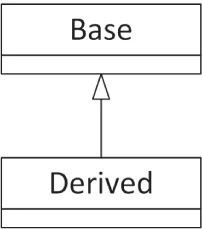
[^FIGURE 10.1]
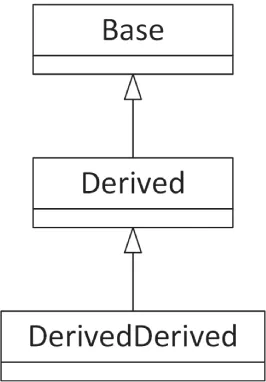
[^FIGURE 10.2]
Derived doesn’t have to be the only derived class of Base. Additional classes can also inherit from Base, effectively becoming siblings to Derived, as shown in Figure 10.3.
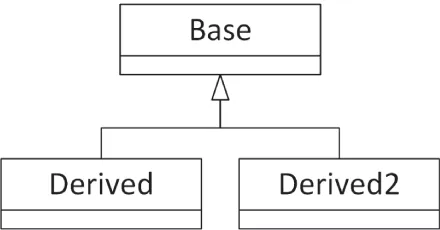
[^FIGURE 10.3]
Internally, a derived class contains an instance of the base class as a subobject. Graphically this can be represented as in Figure 10.4.
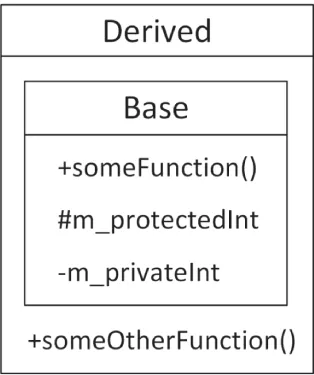
[^FIGURE 10.4]
A Client’s View of Inheritance
Section titled “A Client’s View of Inheritance”To a client, or another part of your code, an object of type Derived is also an object of type Base because Derived inherits from Base. This means that all the public member functions and data members of Base and all the public member functions and data members of Derived are available.
Code that uses the derived class does not need to know which class in your inheritance chain has defined a member function in order to call it. For example, the following code calls two member functions of a Derived object, even though one of the member functions is defined by the Base class:
Derived myDerived;myDerived.someFunction();myDerived.someOtherFunction();It is important to understand that inheritance works in only one direction. The Derived class has a clearly defined relationship to the Base class, but the Base class, as written, doesn’t know anything about the Derived class. That means objects of type Base do not have access to member functions and data members of Derived because Base is not a Derived.
The following code does not compile because the Base class does not contain a public member function called someOtherFunction():
Base myBase;myBase.someOtherFunction(); // Error! Base doesn't have a someOtherFunction().A pointer or reference to a class type can refer to an object of the declared class type or any of its derived classes. This tricky subject is explained in detail later in this chapter. The concept to understand now is that a pointer to Base can actually be pointing to a Derived object. The same is true for a reference. The client can still access only the member functions and data members that exist in Base, but through this mechanism, any code that operates on a Base can also operate on a Derived.
For example, the following code compiles and works just fine, even though it initially appears that there is a type mismatch:
Base* base { new Derived {} }; // Create Derived, store in Base pointer.However, you cannot call member functions from the Derived class through the Base pointer. The following does not work:
base->someOtherFunction();This is flagged as an error by the compiler because, although the object is of type Derived and therefore does have someOtherFunction() defined, the compiler can only think of it as type Base, which does not have someOtherFunction() defined.
A Derived Class’s View of Inheritance
Section titled “A Derived Class’s View of Inheritance”To the derived class, nothing much has changed in terms of how it is written or how it behaves. You can still define member functions and data members on a derived class just as you would on a regular class. The previous definition of Derived declares a member function called someOtherFunction(). Thus, the Derived class augments the Base class by adding an additional member function.
A derived class can access public and protected member functions and data members declared in its base class as though they were its own, because technically they are. For example, the implementation of someOtherFunction() on Derived could make use of the data member m_protectedInt, which is declared as part of Base. The following code shows this. Accessing a base class member is no different than if the member were declared as part of the derived class.
void Derived::someOtherFunction(){ println("I can access base class data member m_protectedInt."); println("Its value is {}", m_protectedInt);}If a class declares members as protected, derived classes have access to them. If they are declared as private, derived classes do not have access. The following implementation of someOtherFunction() does not compile because the derived class attempts to access a private data member from the base class:
void Derived::someOtherFunction(){ println("I can access base class data member m_protectedInt."); println("Its value is {}", m_protectedInt); println("The value of m_privateInt is {}", m_privateInt); // Error!}The private access specifier gives you control over how a potential derived class could interact with your class.
Chapter 4, “Designing Professional C++ Programs,” gives the following rule: all data members should be private; provide public getters and setters if you want to provide access to data members from outside the class. This rule can now be extended to include the protected access specifier.
All data members should be private. Provide public getters and setters if you want to provide access to data members from outside the class and provide protected getters and setters if you want only derived classes to access them.
The reason to make data members private by default is that this provides the highest level of encapsulation. This means that you can change how you represent your data while keeping the public and protected interfaces unchanged. Additionally, without giving direct access to data members, you can easily add checks on the input data in your public and protected setters. Member functions should also be private by default. Only make those member functions public that are designed to be public and make member functions protected if you want only derived classes to have access to them.
The following table summarizes the meaning of all three access specifiers:
| ACCESS SPECIFIER | MEANING | WHEN TO USE |
|---|---|---|
public | Any code can call a public member function or access a public data member of an object. | Behaviors (member functions) that you want clients to use. Access member functions (getters and setters) for private and protected data members. |
protected | Any member function of the class can call protected member functions and access protected data members. Member functions of derived classes can access protected members of a base class. | “Helper” member functions that you do not want clients to use. |
private | Only member functions of the class can call private member functions and access private data members. Member functions in derived classes cannot access private members of a base class. | Everything should be private by default, especially data members. You can provide protected getters and setters if you only want to allow derived classes to access them, and provide public getters and setters if you want clients to access them. |
Preventing Inheritance
Section titled “Preventing Inheritance”C++ allows you to mark a class as final, which means trying to inherit from it will result in a compilation error. A class can be marked as final with the final keyword right behind the name of the class. For example, if a class tries to inherit from the following Foo class, the compiler will produce an error:
class Foo final { };Overriding Member Functions
Section titled “Overriding Member Functions”The main reasons to inherit from a class are to add or replace functionality. The definition of Derived adds functionality to its parent class by providing an additional member function, someOtherFunction(). The other member function, someFunction(), is inherited from Base and behaves in the derived class exactly as it does in the base class. In many cases, you will want to modify the behavior of a class by replacing, or overriding, a member function.
The virtual Keyword
Section titled “The virtual Keyword”Simply defining a member function from a base class in a derived class does not properly override that member function. To correctly override a member function, we need a new C++ keyword called virtual. Only member functions that are declared as virtual in the base class can be overridden properly by derived classes. The keyword goes at the beginning of a member function declaration as shown in the modified version of Base that follows:
class Base{ public: virtual void someFunction(); // Remainder omitted for brevity.};The same holds for the Derived class. Its member functions should also be marked virtual if you want to override them in further derived classes:
class Derived : public Base{ public: virtual void someOtherFunction();};The virtual keyword is not repeated in front of the member function definition, e.g.:
void Base::someFunction(){ println("This is Base's version of someFunction().");}Attempting to override a non-virtual member function from a base class hides the base class definition, and it will be used only in the context of the derived class.
Syntax for Overriding a Member Function
Section titled “Syntax for Overriding a Member Function”To override a member function, you redeclare it in the derived class definition exactly as it was declared in the base class, but you add the override keyword and remove the virtual keyword. For example, if you want to provide a new definition for someFunction() in the Derived class, you must first add it to the class definition for Derived, as follows:
class Derived : public Base{ public: void someFunction() override; // Overrides Base's someFunction() virtual void someOtherFunction();};The new definition of someFunction() is specified along with the rest of Derived’s member functions. Just as with the virtual keyword, you do not repeat the override keyword in the member function definition:
void Derived::someFunction(){ println("This is Derived's version of someFunction().");}If you want, you are allowed to add the virtual keyword in front of overridden member functions, but it’s redundant. Here’s an example:
class Derived : public Base{ public: virtual void someFunction() override; // Overrides Base's someFunction()};Once a member function or destructor is marked as virtual, it is virtual for all derived classes even if the virtual keyword is removed from derived classes.
A Client’s View of Overridden Member Functions
Section titled “A Client’s View of Overridden Member Functions”With the preceding changes, other code still calls someFunction() the same way it did before. Just as before, the member function could be called on an object of class Base or an object of class Derived. Now, however, the behavior of someFunction() varies based on the class of the object.
For example, the following code works just as it did before, calling Base’s version of someFunction():
Base myBase;myBase.someFunction(); // Calls Base's version of someFunction().The output of this code is as follows:
This is Base's version of someFunction().If the code declares an object of class Derived, the other version is automatically called:
Derived myDerived;myDerived.someFunction(); // Calls Derived's version of someFunction()The output this time is as follows:
This is Derived's version of someFunction().Everything else about objects of class Derived remains the same. Other member functions that might have been inherited from Base still have the definition provided by Base unless they are explicitly overridden in Derived.
As you learned earlier, a pointer or reference can refer to an object of a class or any of its derived classes. The object itself “knows” the class of which it is actually a member, so the appropriate member function is called as long as it was declared virtual. For example, if you have a Base reference that refers to an object that is really a Derived, calling someFunction() actually calls the derived class’s version, as shown next. This aspect of overriding does not work properly if you omit the virtual keyword in the base class.
Derived myDerived;Base& ref { myDerived };ref.someFunction(); // Calls Derived's version of someFunction()Remember that even though a Base reference or pointer knows that it is referring to a Derived instance, you cannot access Derived class members that are not defined in Base. The following code does not compile because a Base reference does not have a member function called someOtherFunction():
Derived myDerived;Base& ref { myDerived };myDerived.someOtherFunction(); // This is fine.ref.someOtherFunction(); // ErrorThis derived class knowledge characteristic is not true for nonpointer or nonreference objects. You can cast or assign a Derived to a Base because a Derived is a Base. However, the object loses any knowledge of the Derived class at that point.
Derived myDerived;Base assignedObject { myDerived }; // Assigns a Derived to a Base.assignedObject.someFunction(); // Calls Base's version of someFunction()One way to remember this seemingly strange behavior is to imagine what the objects look like in memory. Picture a Base object as a box taking up a certain amount of memory. A Derived object is a box that is slightly bigger because it has everything a Base has plus a bit more. Whether you have a Derived or Base reference or pointer to a Derived, the box doesn’t change—you just have a new way of accessing it. However, when you cast a Derived into a Base, you are throwing out all the “uniqueness” of the Derived class to fit it into a smaller box.
The override Keyword
Section titled “The override Keyword”The use of the override keyword is optional, but highly recommended. Without the keyword, it is possible to accidentally create a new (virtual) member function in a derived class instead of overriding a member function from the base class, effectively hiding the member function from the base class. Take the following Base and Derived classes where Derived is properly overriding someFunction(), but is not using the override keyword:
class Base{    public:        virtual void someFunction(double d);};
class Derived : public Base{    public:        virtual void someFunction(double d);};
You can call someFunction() through a reference as follows:
Derived myDerived;Base& ref { myDerived };ref.someFunction(1.1); // Calls Derived's version of someFunction()This correctly calls the overridden someFunction() from the Derived class. Now, suppose you accidentally use an integer parameter instead of a double while overriding someFunction(), as follows:
class Derived : public Base{ public: virtual void someFunction(int i);};This code does not override someFunction() from Base, but instead creates a new virtual member function. If you try to call someFunction() through a Base reference as in the following code, someFunction() of Base is called instead of the one from Derived!
Derived myDerived;Base& ref { myDerived };ref.someFunction(1.1); // Calls Base's version of someFunction()This type of problem can happen when you start to modify the Base class but forget to update all derived classes. For example, maybe your first version of the Base class has a member function called someFunction() accepting an integer. You then write the Derived class overriding this someFunction() accepting an integer. Later you decide that someFunction() in Base needs a double instead of an integer, so you update someFunction() in the Base class. It could happen that at that time, you forget to update overrides of someFunction() in derived classes to also accept a double instead of an integer. By forgetting this, you are now actually creating a new virtual member function instead of properly overriding the base member function.
You can prevent this situation by using the override keyword as follows:
class Derived : public Base{ public: void someFunction(int i) override;};This definition of Derived generates a compilation error, because with the override keyword you are saying that someFunction() is supposed to be overriding a member function from a base class, but the Base class has no someFunction() accepting an integer, only one accepting a double.
The problem of accidentally creating a new member function instead of properly overriding one can also happen when you rename a member function in the base class and forget to rename the overriding member functions in derived classes.
Always use the override keyword on member functions that are meant to be overriding member functions from a base class.
The Truth about virtual
Section titled “The Truth about virtual”By now you know that if a member function is not virtual, trying to override it in a derived class will hide the base class’s version of that member function. This section explores how virtual member functions are implemented by the compiler and what their performance impact is, as well as discussing the importance of virtual destructors.
How virtual Is Implemented
Section titled “How virtual Is Implemented”To understand how member function hiding is avoided, you need to know a bit more about what the virtual keyword actually does. When a class is compiled in C++, a binary object is created that contains all member functions for the class. In the non-virtual case, the code to transfer control to the appropriate member function is hard-coded directly where the member function is called based on the compile-time type. This is called static binding, also known as early binding.
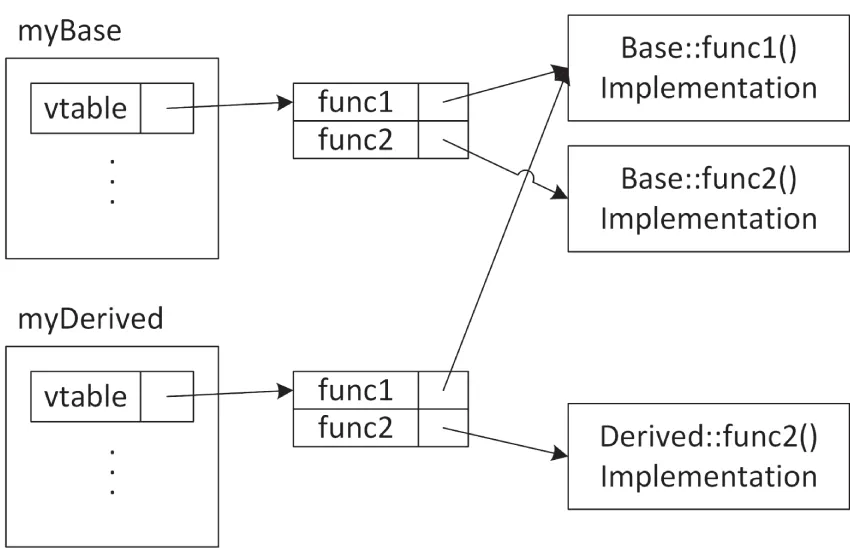
If the member function is declared virtual, the correct implementation is called through the use of a special area of memory called the vtable, or “virtual table.” Each class that has one or more virtual member functions has a vtable, and every object of such a class contains a pointer to said vtable. This vtable contains pointers to the implementations of the virtual member functions. In this way, when a member function is called on a pointer or reference to an object, its vtable pointer is followed, and the appropriate version of the member function is executed based on the actual type of the object at run time. This is called dynamic binding, also known as late binding. It’s important to remember that this dynamic binding works only when using pointers or references to objects. If you call a virtual member function directly on an object, then that call will use static binding resolved at compile time.
To better understand how vtables make overriding of member functions possible, take the following Base and Derived classes as an example:
class Base{    public:        virtual void func1();        virtual void func2();        void nonVirtualFunc();};
class Derived : public Base{    public:        void func2() override;        void nonVirtualFunc();};
For this example, assume that you have the following two instances:
Base myBase;Derived myDerived;Figure 10.5 shows a high-level view of the vtables of both instances. The myBase object contains a pointer to its vtable. This vtable has two entries, one for func1() and one for func2(). Those entries point to the implementations of Base::func1() and Base::func2().
[^FIGURE 10.5]
myDerived also contains a pointer to its vtable, which also has two entries, one for func1() and one for func2(). Its func1() entry points to Base::func1() because Derived does not override func1(). On the other hand, its func2() entry points to Derived::func2().
Note that both vtables do not contain any entry for the nonVirtualFunc() member function because that member function is not virtual.
The Justification for virtual
Section titled “The Justification for virtual”In some languages, such as Java, all member functions are automatically virtual so they can be overridden properly. In C++ that’s not the case. The argument against making everything virtual in C++, and the reason that the keyword was created in the first place, has to do with the overhead of the vtable. To call a virtual member function, the program needs to perform an extra operation by dereferencing the pointer to the appropriate code to execute. This is a miniscule performance hit in most cases, but the designers of C++ thought that it was better, at least at the time, to let the programmer decide if the performance hit was necessary. If the member function was never going to be overridden, there was no need to make it virtual and take the performance hit. However, with today’s CPUs, the performance hit is measured in fractions of a nanosecond, and this will keep getting smaller with future CPUs. In most applications, you will not have a measurable performance difference between using virtual member functions and avoiding them.
Still, in certain specific use cases, the performance overhead might be too costly, and you may need to have an option to avoid the hit. For example, suppose you have a Point class that has a virtual member function. If you have another data structure that stores millions or even billions of Points, calling a virtual member function on each point creates significant overhead. In that case, it’s probably wise to avoid any virtual member functions in your Point class.
There is also a tiny hit to memory usage for each object. In addition to the implementation of the member function, each object also needs a pointer for its vtable, which takes up a tiny amount of space. This is not an issue in the majority of cases. However, sometimes it does matter. Take again the Point class and the container storing billions of Points. In that case, the additional required memory becomes significant.
The Need for virtual Destructors
Section titled “The Need for virtual Destructors”Destructors should almost always be virtual. Making your destructors non-virtual can easily result in situations in which memory is not freed by object destruction. Only for a class that is marked as final could you make its destructor non-virtual.
For example, if a derived class uses memory that is dynamically allocated in the constructor and deleted in the destructor, it will never be freed if the destructor is never called. Similarly, if your derived class has members that are automatically deleted when an instance of the class is destroyed, such as std::unique_ptrs, then those members will not get deleted either if the destructor is never called.
As the following code shows, it is easy to “trick” the compiler into skipping the call to the destructor if it is non-virtual:
class Base{    public:        Base() = default;        ˜Base() {}};
class Derived : public Base{    public:        Derived()        {            m_string = new char[30];            println("m_string allocated");        }
        ˜Derived()        {            delete[] m_string;            println("m_string deallocated");        }    private:        char* m_string;};
int main(){    Base* ptr { new Derived {} };   // m_string is allocated here.    delete ptr; // ˜Base is called, but not ˜Derived because the destructor                // is not virtual!}
As you can see from the following output, the destructor of the Derived object is never called, that is, the “m_string deallocated” message is never displayed:
m_string allocatedTechnically, the behavior of the delete call in the preceding code is undefined by the standard. A C++ compiler could do whatever it wants in such undefined situations. However, most compilers simply call the destructor of the base class, and not the destructor of the derived class.
The fix is to mark the destructor in the base class as virtual. If you don’t need to do any extra work in that destructor but want to make it virtual, you can explicitly default it. Here’s an example:
class Base{ public: Base() = default; virtual ˜Base() = default;};With this change, the output is as expected:
m_string allocatedm_string deallocatedNote that since C++11, the generation of a copy constructor and copy assignment operator is deprecated if the class has a user-declared destructor. Basically, once you have a user-declared destructor, the rule of five kicks in. This means you need to declare a copy constructor, copy assignment operator, move constructor, and move assignment operator, possibly by explicitly defaulting them. This is not done in the examples in this chapter in the interest of keeping them concise and to the point.
Unless you have a specific reason not to, or the class is marked as final, destructors should be marked as virtual. Constructors cannot and need not be virtual because you always specify the exact class being constructed when creating an object.
Earlier in this chapter it was advised to use the override keyword on member functions that are meant to override base class member functions. It’s also possible to use the override keyword on a destructor. This makes sure that the compiler will trigger an error if the destructor in the base class is not virtual. You can combine virtual, override, and default. Here’s an example:
class Derived : public Base{ public: virtual ˜Derived() override = default;};Preventing Overriding
Section titled “Preventing Overriding”Besides marking an entire class as final, C++ also allows you to mark individual member functions as final. Such member functions cannot be overridden in a further derived class. For example, overriding someFunction() from the following Derived class in DerivedDerived results in a compilation error:
class Base{ public: virtual ˜Base() = default; virtual void someFunction();};class Derived : public Base{ public: void someFunction() override final;};class DerivedDerived : public Derived{ public: void someFunction() override; // Compilation error.};INHERITANCE FOR REUSE
Section titled “INHERITANCE FOR REUSE”Now that you are familiar with the basic syntax for inheritance, it’s time to explore one of the main reasons that inheritance is an important feature of the C++ language. Inheritance is a vehicle that allows you to leverage existing code. This section presents an example of inheritance for the purpose of code reuse.
The WeatherPrediction Class
Section titled “The WeatherPrediction Class”Imagine that you are given the task of writing a program to issue simple weather predictions, working with both Fahrenheit and Celsius. Weather predictions may be a little bit out of your area of expertise as a programmer, so you obtain a third-party class library that was written to make weather predictions based on the current temperature and the current distance between Jupiter and Mars (hey, it’s plausible). This third-party package is distributed as a compiled library to protect the intellectual property of the prediction algorithms, but you do get to see the class definition. The weather_prediction module interface file looks as follows:
export module weather_prediction;import std;// Predicts the weather using proven new-age techniques given the current// temperature and the distance from Jupiter to Mars. If these values are// not provided, a guess is still given but it's only 99% accurate.export class WeatherPrediction{ public: // Virtual destructor virtual ˜WeatherPrediction(); // Sets the current temperature in Fahrenheit virtual void setCurrentTempFahrenheit(int temp); // Sets the current distance between Jupiter and Mars virtual void setPositionOfJupiter(int distanceFromMars); // Gets the prediction for tomorrow's temperature virtual int getTomorrowTempFahrenheit() const; // Gets the probability of rain tomorrow. 1 means // definite rain. 0 means no chance of rain. virtual double getChanceOfRain() const; // Displays the result to the user in this format: // Result: x.xx chance. Temp. xx virtual void showResult() const; // Returns a string representation of the temperature virtual std::string getTemperature() const; private: int m_currentTempFahrenheit { 0 }; int m_distanceFromMars { 0 };};Note that this class marks all member functions as virtual, because the class presumes that they might get overridden in derived classes.
This class solves most of the problems for your program. However, as is usually the case, it’s not exactly right for your needs. First, all the temperatures are given in Fahrenheit. Your program needs to operate in Celsius as well. Also, the showResult() member function might not display the result in a way you require.
Adding Functionality in a Derived Class
Section titled “Adding Functionality in a Derived Class”When you learned about inheritance in Chapter 5, adding functionality was the first technique described. Fundamentally, your program needs something just like the WeatherPrediction class but with a few extra bells and whistles. Sounds like a good case for inheritance to reuse code. To begin, define a new class, MyWeatherPrediction, that inherits from WeatherPrediction:
import weather_prediction;
export class MyWeatherPrediction : public WeatherPrediction{};
The preceding class definition compiles just fine. The MyWeatherPrediction class can already be used in place of WeatherPrediction. It provides the same functionality, but nothing new yet. For the first modification, you might want to add knowledge of the Celsius scale to the class. There is a bit of a quandary here because you don’t know what the class is doing internally. If all of the internal calculations are made using Fahrenheit, how do you add support for Celsius? One way is to use the derived class to act as a go-between, interfacing between the user, who can use either scale, and the base class, which only understands Fahrenheit.
The first step in supporting Celsius is to add new member functions that allow clients to set the current temperature in Celsius instead of Fahrenheit and to get tomorrow’s prediction in Celsius instead of Fahrenheit. You also need private helper functions that convert between Celsius and Fahrenheit in both directions. These functions can be static because they are the same for all instances of the class.
export class MyWeatherPrediction : public WeatherPrediction{ public: virtual void setCurrentTempCelsius(int temp); virtual int getTomorrowTempCelsius() const; private: static int convertCelsiusToFahrenheit(int celsius); static int convertFahrenheitToCelsius(int fahrenheit);};The new member functions follow the same naming convention as the parent class. Remember that from the point of view of other code, a MyWeatherPrediction object has all of the functionality defined in both MyWeatherPrediction and WeatherPrediction. Adopting the parent class’s naming convention presents a consistent interface.
The implementation of the Celsius/Fahrenheit conversion functions is left as an exercise for the reader—and a fun one at that! The other two member functions are more interesting. To set the current temperature in Celsius, you need to convert the temperature first and then present it to the parent class in units that it understands:
void MyWeatherPrediction::setCurrentTempCelsius(int temp){ int fahrenheitTemp { convertCelsiusToFahrenheit(temp) }; setCurrentTempFahrenheit(fahrenheitTemp);}As you can see, once the temperature is converted, the member function calls the existing functionality from the base class. Similarly, the implementation of getTomorrowTempCelsius() uses the parent’s existing functionality to get the temperature in Fahrenheit, but converts the result before returning it:
int MyWeatherPrediction::getTomorrowTempCelsius() const{ int fahrenheitTemp { getTomorrowTempFahrenheit() }; return convertFahrenheitToCelsius(fahrenheitTemp);}The two new member functions effectively reuse the parent class because they “wrap” the existing functionality in a way that provides a new interface for using it.
You can also add new functionality completely unrelated to existing functionality of the parent class. For example, you could add a member function that retrieves alternative forecasts from the Internet or a member function that suggests an activity based on the predicted weather.
Replacing Functionality in a Derived Class
Section titled “Replacing Functionality in a Derived Class”The other major technique for inheritance is replacing existing functionality. The showResult() member function in the WeatherPrediction class is in dire need of a facelift. MyWeatherPrediction can override this member function to replace the behavior with its own implementation.
The new class definition for MyWeatherPrediction is as follows:
export class MyWeatherPrediction : public WeatherPrediction{ public: virtual void setCurrentTempCelsius(int temp); virtual int getTomorrowTempCelsius() const; void showResult() const override; private: static int convertCelsiusToFahrenheit(int celsius); static int convertFahrenheitToCelsius(int fahrenheit);};Here is a new, user-friendlier implementation of the overridden showResult() member function:
void MyWeatherPrediction::showResult() const{ println("Tomorrow will be {} degrees Celsius ({} degrees Fahrenheit)", getTomorrowTempCelsius(), getTomorrowTempFahrenheit()); println("Chance of rain is {}%", getChanceOfRain() * 100); if (getChanceOfRain()> 0.5) { println("Bring an umbrella!"); }}To clients using this class, it’s as if the old version of showResult() never existed. As long as the object is a MyWeatherPrediction object, the new version is called. As a result of these changes, MyWeatherPrediction has emerged as a new class with new functionality tailored to a more specific purpose. Yet, it did not require much code because it leveraged its base class’s existing functionality.
RESPECT YOUR PARENTS
Section titled “RESPECT YOUR PARENTS”When you write a derived class, you need to be aware of the interaction between parent classes and child classes. Issues such as order of creation, constructor chaining, and casting are all potential sources of bugs.
Parent Constructors
Section titled “Parent Constructors”Objects don’t spring to life all at once; they must be constructed along with their parents and any objects that are contained within them. C++ defines the creation order as follows:
- If the class has a base class, the default constructor of the base class is executed, unless there is a call to a base class constructor in the ctor-initializer, in which case that constructor is called instead of the default constructor.
- Non-
staticdata members of the class are constructed in the order in which they are declared. - The body of the class’s constructor is executed.
These rules can apply recursively. If the class has a grandparent, the grandparent is initialized before the parent, and so on. The following code shows this creation order. The proper execution of this code outputs 123.
class Something{    public:        Something() { print("2"); }};
class Base{    public:        Base() { print("1"); }};
class Derived : public Base{    public:        Derived() { print("3"); }    private:        Something m_dataMember;};
int main(){    Derived myDerived;}
When the myDerived object is created, the constructor for Base is called first, outputting the string "1". Next, m_dataMember is initialized, calling the Something constructor, which outputs the string "2". Finally, the Derived constructor is called, which outputs "3".
Note that the Base constructor is called automatically. C++ automatically calls the default constructor for the parent class if one exists. If no default constructor exists in the parent class or if one does exist but you want to use an alternate parent constructor, you can chain the constructor just as when initializing data members in the ctor-initializer. For example, the following code shows a version of Base that lacks a default constructor. The associated version of Derived must explicitly tell the compiler how to call the Base constructor or the code will not compile.
class Base{    public:        explicit Base(int i) {}};
class Derived : public Base{    public:        Derived() : Base { 7 } { /* Other Derived's initialization … */ }};
The Derived constructor passes a fixed value (7) to the Base constructor. Of course, Derived could also pass a variable:
Derived::Derived(int i) : Base { i } { /* Other Derived's initialization … */ }Passing constructor arguments from the derived class to the base class is perfectly fine and quite normal. Passing data members, however, will not work. The code will compile, but remember that data members are not initialized until after the base class is constructed. If you pass a data member as an argument to the parent constructor, it will be uninitialized.
Parent Destructors
Section titled “Parent Destructors”Because destructors cannot take arguments, the language can always automatically call the destructor for parent classes. The order of destruction is conveniently the reverse of the order of construction:
- The body of the class’s destructor is called.
- Any data members of the class are destroyed in the reverse order of their construction.
- The parent class, if any, is destructed.
Again, these rules apply recursively. The lowest member of the chain is always destructed first. The following code adds destructors to the earlier example. The destructors are all declared virtual! If executed, this code outputs "123321".
class Something{    public:        Something() { print("2"); }        virtual ˜Something() { print("2"); }};
class Base{    public:        Base() { print("1"); }        virtual ˜Base() { print("1"); }};
class Derived : public Base{    public:        Derived() { print("3"); }        virtual ˜Derived() override { print("3"); }    private:        Something m_dataMember;};
If the preceding destructors were not declared virtual, the code would seem to work fine. However, if code ever called delete on a Base pointer that was really pointing to a Derived instance, the destruction chain would begin in the wrong place. For example, if you remove the virtual and override keywords from all destructors in the previous code, then a problem arises when a Derived object is accessed as a pointer to a Base and deleted, as shown here:
Base* ptr { new Derived{} };delete ptr;The output of this code is a shockingly terse "1231". When the ptr variable is deleted, only the Base destructor is called because the destructor was not declared virtual. As a result, the Derived destructor is not called, and the destructors for its data members are not called!
Technically, you could fix the preceding problem by marking only the Base destructor virtual. The “virtualness” automatically applies to any derived classes. However, I advocate explicitly making all destructors virtual so that you never have to worry about it.
Always make your destructors virtual! The compiler-generated default destructor is not virtual, so you should define (or explicitly default) a virtual destructor, at least for your non-final base classes.
virtual Member Function Calls within Constructors and Destructor
Section titled “virtual Member Function Calls within Constructors and Destructor”virtual member functions behave differently in constructors and destructors. If your derived class has overridden a virtual member function from a base class, calling that member function from a base class constructor or destructor calls the base class implementation of that virtual member function and not your overridden version in the derived class! In other words, calls to virtual member functions from within a constructor or destructor are resolved statically at compile time.
The reason for this behavior of constructors has to do with the order of initialization when constructing an instance of a derived class. When creating such an instance, the constructor of any base class is called first, before the derived class instance is fully initialized. Hence, it would be dangerous to already call overridden virtual member functions from the not-yet-fully initialized derived class. A similar reasoning holds for destructors due to the order of destruction when destroying an object.
If you really need polymorphic behavior in your constructors, although this is not recommended, you can define an initialize() virtual member function in your base class, which derived classes can override. Clients creating an instance of your class will have to call this initialize() member function after construction has finished.
Similarly, if you need polymorphic behavior in your destructor, again, not recommended, you can define a shutdown() virtual member function that clients then need to call before the object is destroyed.
Referring to Parent Names
Section titled “Referring to Parent Names”When you override a member function in a derived class, you are effectively replacing the original as far as other code is concerned. However, that parent version of the member function still exists, and you may want to make use of it. For example, an overridden member function would like to keep doing what the base class implementation does, plus something else. Take a look at the getTemperature() member function in the WeatherPrediction class that returns a string representation of the current temperature:
export class WeatherPrediction{ public: virtual std::string getTemperature() const; // Remainder omitted for brevity.};You can override this member function in the MyWeatherPrediction class as follows:
export class MyWeatherPrediction : public WeatherPrediction{ public: std::string getTemperature() const override; // Remainder omitted for brevity.};Suppose the derived class wants to add °F to the string by first calling the base class’s getTemperature() member function and then adding °F to it. You might write this as follows:
string MyWeatherPrediction::getTemperature() const{ // Note: \u00B0 is the ISO/IEC 10646 representation of the degree symbol. return getTemperature() + "\u00B0F"; // BUG}However, this does not work because, under the rules of name resolution for C++, it first resolves against the local scope, then resolves against the class scope, and as a result ends up calling MyWeatherPrediction::getTemperature(). This causes an infinite recursion until you run out of stack space (some compilers detect this error and report it at compile time).
To make this work, you need to use the scope resolution operator as follows:
string MyWeatherPrediction::getTemperature() const{ // Note: \u00B0 is the ISO/IEC 10646 representation of the degree symbol. return WeatherPrediction::getTemperature() + "\u00B0F";}Calling the parent version of the current member function is a commonly used pattern in C++. If you have a chain of derived classes, each might want to perform the operation already defined by the base class but add their own additional functionality as well.
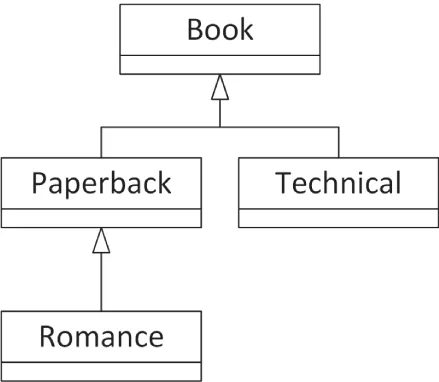
Let’s look at another example. Imagine a class hierarchy of book types, as shown in Figure 10.6.
[^FIGURE 10.6]
Because each lower class in the hierarchy further specifies the type of book, a member function that gets the description of a book really needs to take all levels of the hierarchy into consideration. This can be accomplished by chaining to the parent member function. The following code illustrates this pattern:
class Book{    public:        virtual ˜Book() = default;        virtual string getDescription() const { return "Book"; }        virtual int getHeight() const { return 120; }};
class Paperback : public Book{    public:        string getDescription() const override {            return "Paperback " + Book::getDescription();        }};
class Romance : public Paperback{    public:        string getDescription() const override {            return "Romance " + Paperback::getDescription();        }        int getHeight() const override { return Paperback::getHeight() / 2; }};
class Technical : public Book{    public:        string getDescription() const override {            return "Technical " + Book::getDescription();        }};
int main(){    Romance novel;    Book book;    println("{}", novel.getDescription()); // Outputs "Romance Paperback Book"    println("{}", book.getDescription());  // Outputs "Book"    println("{}", novel.getHeight());      // Outputs "60"    println("{}", book.getHeight());       // Outputs "120"}
The Book base class has two virtual member functions: getDescription() and getHeight(). All derived classes override getDescription(), but only the Romance class overrides getHeight() by calling getHeight() on its parent class (Paperback) and dividing the result by two. Paperback does not override getHeight(), but C++ walks up the class hierarchy to find a class that implements getHeight(). In this example, Paperback::getHeight() resolves to Book::getHeight().
Casting Up and Down
Section titled “Casting Up and Down”As you have already seen, an object can be cast or assigned to its parent class. Here’s an example:
Derived myDerived;Base myBase { myDerived }; // Slicing!Slicing occurs in situations like this because the end result is a Base object, and Base objects lack the additional functionality defined in the Derived class. However, slicing does not occur if a derived class is assigned to a pointer or reference to its base class:
Base& myBase { myDerived }; // No slicing!This is generally the correct way to refer to a derived class in terms of its base class, also called upcasting. This is why it’s always a good idea for functions to take references to classes instead of directly using objects of those classes. By using references, derived classes can be passed in without slicing.
When upcasting, use a pointer or reference to the base class to avoid slicing.
Casting from a base class to one of its derived classes, also called downcasting, is often frowned upon by professional C++ programmers because there is no guarantee that the object really belongs to that derived class and because downcasting is a sign of bad design. For example, consider the following code:
void presumptuous(Base* base){ Derived* myDerived { static_cast<Derived*>(base) }; // Proceed to access Derived member functions on myDerived.}If the author of presumptuous() also writes the code that calls presumptuous(), everything will probably be OK, albeit still ugly, because the author knows that the function expects the argument to be of type Derived*. However, if other programmers call presumptuous(), they might pass in a Base*. There are no compile-time checks that can be done to enforce the type of the argument, and the function blindly assumes that base is actually a pointer to a Derived object.
Downcasting is sometimes necessary, and you can use it effectively in controlled circumstances. However, if you are going to downcast, you should use a dynamic_cast(), which uses the object’s built-in knowledge of its type to refuse a cast that doesn’t make sense. This built-in knowledge typically resides in the vtable, which means that dynamic_cast() works only for objects with a vtable, that is, objects with at least one virtual member. If a dynamic_cast() fails on a pointer, the result will be nullptr instead of pointing to nonsensical data. If a dynamic_cast() fails on an object reference, an std::bad_cast exception will be thrown. The last section of this chapter discusses the different options for casting in more detail.
The previous example could have been written as follows:
void lessPresumptuous(Base* base){ Derived* myDerived { dynamic_cast<Derived*>(base) }; if (myDerived != nullptr) { // Proceed to access Derived member functions on myDerived. }}However, keep in mind that the use of downcasting is often a sign of a bad design. You should rethink and modify your design so that downcasting can be avoided. For example, the lessPresumptuous() function only really works with Derived objects, so instead of accepting a Base pointer, it should simply accept a Derived pointer. This eliminates the need for any downcasting. If the function should work with different derived classes, all inheriting from Base, then look for a solution that uses polymorphism, which is discussed next.
Use downcasting only when really necessary, and be sure to use dynamic_cast().
INHERITANCE FOR POLYMORPHISM
Section titled “INHERITANCE FOR POLYMORPHISM”Now that you understand the relationship between a derived class and its parent, you can use inheritance in its most powerful scenario—polymorphism. Chapter 5 discusses how polymorphism allows you to use objects with a common parent class interchangeably and to use objects in place of their parents.
Return of the Spreadsheet
Section titled “Return of the Spreadsheet”Chapters 8 and 9 use a spreadsheet program as an example of an application that lends itself to an object-oriented design. A SpreadsheetCell represents a single element of data. Up to now, that element always stored a single double value. A simplified class definition for SpreadsheetCell follows. Note that a cell can be set either as a double or as a string_view, but it is always stored as a double. The current value of the cell, however, is always returned as a string for this example.
class SpreadsheetCell{ public: virtual void set(double value); virtual void set(std::string_view value); virtual std::string getString() const; private: static std::string doubleToString(double value); static double stringToDouble(std::string_view value); double m_value;};In a real spreadsheet application, cells can store different things. A cell could store a double, but it might just as well store a piece of text. There could also be a need for additional types of cells, such as a formula cell or a date cell. How can you support this?
Designing the Polymorphic Spreadsheet Cell
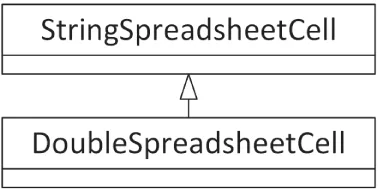
Section titled “Designing the Polymorphic Spreadsheet Cell”The SpreadsheetCell class is screaming out for a hierarchical makeover. A reasonable approach would be to narrow the scope of the SpreadsheetCell to cover only strings, perhaps renaming it to StringSpreadsheetCell in the process. To handle doubles, a second class, DoubleSpreadsheetCell, would inherit from the StringSpreadsheetCell and provide functionality specific to its own format. Figure 10.7 illustrates such a design. This approach models inheritance for reuse because the DoubleSpreadsheetCell would be deriving from StringSpreadsheetCell only to make use of some of its built-in functionality.
[^FIGURE 10.7]
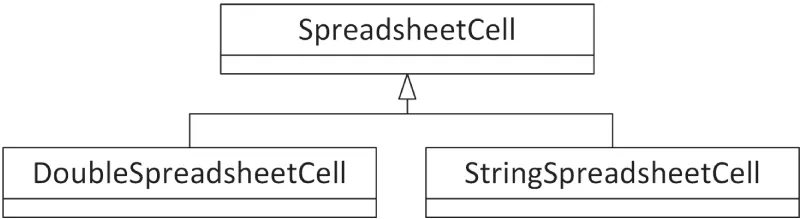
If you were to implement the design shown in Figure 10.7, you might discover that the derived class would override most, if not all, of the functionality of the base class. Because doubles are treated differently from strings in almost all cases, the relationship may not be quite as it was originally understood. Yet, there clearly is a relationship between a cell containing strings and a cell containing doubles. Rather than using the model in Figure 10.7, which implies that somehow a DoubleSpreadsheetCell “is-a” StringSpreadsheetCell, a better design would make these classes peers with a common parent, SpreadsheetCell. Figure 10.8 shows such a design.
[^FIGURE 10.8]
The design in Figure 10.8 shows a polymorphic approach to the SpreadsheetCell hierarchy. Because DoubleSpreadsheetCell and StringSpreadsheetCell both inherit from a common parent, SpreadsheetCell, they are interchangeable in the view of other code. In practical terms, that means the following:
- Both derived classes support the same interface (set of member functions) defined by the base class.
- Code that makes use of
SpreadsheetCellobjects can call any member function in the interface without even knowing whether the cell is aDoubleSpreadsheetCellor aStringSpreadsheetCell. - Through the magic of
virtualmember functions, the appropriate instance of every member function in the interface is called depending on the class of the object. - Other data structures, such as the
Spreadsheetclass described in Chapter 9, can contain a collection of multityped cells by referring to the base type.
The SpreadsheetCell Base Class
Section titled “The SpreadsheetCell Base Class”Because all spreadsheet cells are deriving from the SpreadsheetCell base class, it is probably a good idea to write that class first. When designing a base class, you need to consider how the derived classes relate to each other. From this information, you can derive the commonality that will go inside the parent class. For example, string cells and double cells are similar in that they both contain a single piece of data. Because the data is coming from the user and will be displayed back to the user, the value is set as a string and retrieved as a string. These behaviors are the shared functionality that will make up the base class.
A First Attempt
Section titled “A First Attempt”The SpreadsheetCell base class is responsible for defining the behaviors that all SpreadsheetCell-derived classes will support. In this example, all cells need to be able to set their value as a string. All cells also need to be able to return their current value as a string. The base class definition declares these member functions, as well as an explicitly defaulted virtual destructor, but note that it has no data members. The definition is in a spreadsheet_cell module.
export module spreadsheet_cell;import std;
export class SpreadsheetCell{    public:        virtual ˜SpreadsheetCell() = default;        virtual void set(std::string_view value);        virtual std::string getString() const;};
When you start writing the .cpp file for this class, you quickly run into a problem. Considering that the base class of the spreadsheet cell contains neither a double nor a string data member, how can you implement it? More generally, how do you write a base class that declares the behaviors that are supported by derived classes without actually defining the implementation of those behaviors?
One possible approach is to implement “do nothing” functionality for those behaviors. For example, calling the set() member function on the SpreadsheetCell base class will have no effect because the base class has nothing to set. This approach still doesn’t feel right, however. Ideally, there should never be an object that is an instance of the base class. Calling set() should always have an effect because it should always be called on either a DoubleSpreadsheetCell or a StringSpreadsheetCell. A good solution enforces this constraint.
Pure virtual Member Functions and Abstract Base Classes
Section titled “Pure virtual Member Functions and Abstract Base Classes”Pure virtual member functions are member functions that are explicitly undefined in the class definition. By making a member function pure virtual, you are telling the compiler that no definition for the member function exists in the current class. A class with at least one pure virtual member function is said to be an abstract class because no other code will be able to instantiate it. The compiler enforces the fact that if a class contains one or more pure virtual member functions, it can never be used to construct an object of that type.
There is a special syntax for designating a pure virtual member function. The member function declaration is followed by =0. No implementation needs to be written.
export class SpreadsheetCell{ public: virtual ˜SpreadsheetCell() = default; virtual void set(std::string_view value) = 0; virtual std::string getString() const = 0;};Now that the base class is an abstract class, it is impossible to create a SpreadsheetCell object. The following code does not compile and returns an error such as “‘SpreadsheetCell’: cannot instantiate abstract class”:
SpreadsheetCell cell; // Error! Attempts creating abstract class instance.However, once the StringSpreadsheetCell class has been implemented, the following code will compile fine because it instantiates a derived class of the abstract base class:
unique_ptr<SpreadsheetCell> cell { new StringSpreadsheetCell {} };Note that there is nothing to implement for the SpreadsheetCell class. All member functions are pure virtual, and the destructor is explicitly defaulted.
The Individual Derived Classes
Section titled “The Individual Derived Classes”Writing the StringSpreadsheetCell and DoubleSpreadsheetCell classes is just a matter of implementing the functionality that is defined in the parent. Because you want clients to be able to instantiate and work with string cells and double cells, the cells can’t be abstract—they must implement all of the pure virtual member functions inherited from their parent. If a derived class does not implement all pure virtual member functions from the base class, then the derived class is abstract as well, and clients will not be able to instantiate objects of the derived class.
StringSpreadsheetCell Class Definition
Section titled “StringSpreadsheetCell Class Definition”The StringSpreadsheetCell class is defined in its own module called string_spreadsheet_cell. The first step in writing the class definition of StringSpreadsheetCell is to inherit from SpreadsheetCell. For this, the spreadsheet_cell module needs to be imported.
Next, the inherited pure virtual member functions are overridden, this time without being set to zero.
Finally, the string cell adds a private data member, m_value, which stores the actual cell data. This data member is an std::optional, introduced in Chapter 1, “A Crash Course in C++ and the Standard Library.” By using an optional, it is possible to distinguish whether a value for a cell has never been set or whether it was set to the empty string.
export module string_spreadsheet_cell;export import spreadsheet_cell;import std;
export class StringSpreadsheetCell : public SpreadsheetCell{    public:        void set(std::string_view value) override;        std::string getString() const override;    private:        std::optional<std::string> m_value;};
StringSpreadsheetCell Implementation
Section titled “StringSpreadsheetCell Implementation”The set() member function is straightforward because the internal representation is already a string. The getString() member function has to keep into account that m_value is of type optional and that it might not have a value. When m_value doesn’t have a value, getString() should return a default string, the empty string for this example. This is made easy with the value_or() member function of optional. By using m_value.value_or(""), the real value is returned if m_value contains an actual value; otherwise, the empty string is returned.
void set(std::string_view value) override { m_value = value; }std::string getString() const override { return m_value.value_or(""); }DoubleSpreadsheetCell Class Definition and Implementation
Section titled “DoubleSpreadsheetCell Class Definition and Implementation”The double version follows a similar pattern, but with different logic. In addition to the set() member function from the base class that takes a string_view, it also provides a new set() member function that allows a client to set the value with a double argument. Additionally, it provides a new getValue() member function to retrieve the value as a double. Two new private static member functions are used to convert between a string and a double, and vice versa. As in StringSpreadsheetCell, it has a data member called m_value, this time of type optional<double>.
export module double_spreadsheet_cell;export import spreadsheet_cell;import std;
export class DoubleSpreadsheetCell : public SpreadsheetCell{    public:        virtual void set(double value);        virtual double getValue() const;
        void set(std::string_view value) override;        std::string getString() const override;    private:        static std::string doubleToString(double value);        static double stringToDouble(std::string_view value);        std::optional<double> m_value;};
The set() member function that takes a double is straightforward, as is the implementation of getValue(). The string_view overload uses the private static member function stringToDouble(). The getString() member function returns the stored double value as a string, or returns an empty string if no value has been stored. It uses the has_value() member function of std::optional to query whether the optional has a value. If it has a value, the value() member function is used to retrieve it.
virtual void set(double value) { m_value = value; }virtual double getValue() const { return m_value.value_or(0); }
void set(std::string_view value) override { m_value = stringToDouble(value); }std::string getString() const override{    return (m_value.has_value() ? doubleToString(m_value.value()) : "");}
You may already see one major advantage of implementing spreadsheet cells in a hierarchy—the code is much simpler. Each class can be self-centered and deal only with its own functionality.
Note that the implementations of doubleToString() and stringToDouble() are omitted because they are the same as in Chapter 8.
Leveraging Polymorphism
Section titled “Leveraging Polymorphism”Now that the SpreadsheetCell hierarchy is polymorphic, client code can take advantage of the many benefits that polymorphism has to offer. The following test program explores many of these features.
To demonstrate polymorphism, the test program declares a vector of three SpreadsheetCell pointers. Remember that because SpreadsheetCell is an abstract class, you can’t create objects of that type. However, you can still have a pointer or reference to a SpreadsheetCell because it would actually be pointing to one of the derived classes. This vector, because it is a vector of the parent type SpreadsheetCell, allows you to store a heterogeneous mixture of the two derived classes. This means that elements of the vector could be either a StringSpreadsheetCell or a DoubleSpreadsheetCell.
vector<unique_ptr<SpreadsheetCell>> cellArray;The first two elements of the vector are set to point to a new StringSpreadsheetCell, while the third is a new DoubleSpreadsheetCell.
cellArray.push_back(make_unique<StringSpreadsheetCell>());cellArray.push_back(make_unique<StringSpreadsheetCell>());cellArray.push_back(make_unique<DoubleSpreadsheetCell>());Now that the vector contains multityped data, any of the member functions declared by the base class can be applied to the objects in the vector. The code just uses SpreadsheetCell pointers—the compiler has no idea at compile time what types the objects actually are. However, because the objects are inheriting from SpreadsheetCell, they must support the member functions of SpreadsheetCell.
cellArray[0]->set("hello");cellArray[1]->set("10");cellArray[2]->set("18");When the getString() member function is called, each object properly returns a string representation of their value. The important, and somewhat amazing, thing to realize is that the different objects do this in different ways. A StringSpreadsheetCell returns its stored value, or an empty string. A DoubleSpreadsheetCell first performs a conversion if it contains a value; otherwise, it returns an empty string. As the programmer, you don’t need to know how the object does it—you just need to know that because the object is a SpreadsheetCell, it can perform this behavior.
println("Vector: [{},{},{}]", cellArray[0]->getString(), cellArray[1]->getString(), cellArray[2]->getString());Future Considerations
Section titled “Future Considerations”The new implementation of the SpreadsheetCell hierarchy is certainly an improvement from an object-oriented design point of view. Yet, it would probably not suffice as an actual class hierarchy for a real-world spreadsheet program for several reasons.
First, despite the improved design, one feature is still missing: the ability to convert from one cell type to another. By dividing them into two classes, the cell objects become more loosely integrated. To provide the ability to convert from a DoubleSpreadsheetCell to a StringSpreadsheetCell, you could add a converting constructor, also known as a typed constructor. It has a similar appearance as a copy constructor, but instead of a reference to an object of the same class, it takes a reference to an object of a sibling class. Note also that you now have to declare a default constructor, which can be explicitly defaulted, because the compiler stops generating one as soon as you declare any constructor yourself.
export class StringSpreadsheetCell : public SpreadsheetCell{ public: StringSpreadsheetCell() = default; StringSpreadsheetCell(const DoubleSpreadsheetCell& cell) : m_value { cell.getString() } { } // Remainder omitted for brevity.};With a converting constructor, you can easily create a StringSpreadsheetCell given a DoubleSpreadsheetCell. Don’t confuse this with casting pointers or references, however. Casting from one sibling pointer or reference to another does not work, unless you overload the cast operator as described in Chapter 15, “Overloading C++ Operators.”
You can always cast up the hierarchy, and you can sometimes cast down the hierarchy. Casting across the hierarchy is possible by changing the behavior of the cast operator or by using reinterpret_cast(), neither of which is recommended.
Second, the question of how to implement overloaded operators for cells is an interesting one, and there are several possible approaches.
One approach is to implement a version of each operator for every combination of cells. With only two derived classes, this is manageable. There would be an operator+ function to add two double cells, to add two string cells, and to add a double cell to a string cell. For each combination, you decide what the result is. For example, the result of adding two double cells could be the result of mathematically adding both values together. The result of adding two string cells could be a string representing the concatenation of both strings, and so on.
Another approach is to decide on a common representation. The earlier implementation already standardizes on a string as a common representation of sorts. A single operator+ could cover all the cases by taking advantage of this common representation.
Yet another approach is a hybrid one. One operator+ can be provided that adds two DoubleSpreadsheetCells resulting in a DoubleSpreadsheetCell. This operator can be implemented in the double_spreadsheet_cell module as follows:
export DoubleSpreadsheetCell operator+(const DoubleSpreadsheetCell& lhs, const DoubleSpreadsheetCell& rhs){ DoubleSpreadsheetCell newCell; newCell.set(lhs.getValue() + rhs.getValue()); return newCell;}This operator can be tested as follows:
DoubleSpreadsheetCell doubleCell; doubleCell.set(8.4);DoubleSpreadsheetCell result { doubleCell + doubleCell };println("{}", result.getString()); // Prints 16.800000A second operator+ can be provided for use when at least one of the two operands is a StringSpreadsheetCell. You could decide that the result of this operator should always be a string cell. Such an operator can be added to the string_spreadsheet_cell module and can be implemented as follows:
export StringSpreadsheetCell operator+(const StringSpreadsheetCell& lhs, const StringSpreadsheetCell& rhs){ StringSpreadsheetCell newCell; newCell.set(lhs.getString() + rhs.getString()); return newCell;}As long as the compiler has a way to turn a particular cell into a StringSpreadsheetCell, the operator will work. Given the previous example of having a StringSpreadsheetCell constructor that takes a DoubleSpreadsheetCell as an argument, the compiler will automatically perform the conversion if it is the only way to get the operator+ to work. That means the following code adding a double cell to a string cell works, even though there are only two operator+ implementations provided: one adding two double cells and one adding two string cells.
DoubleSpreadsheetCell doubleCell; doubleCell.set(8.4);StringSpreadsheetCell stringCell; stringCell.set("Hello ");StringSpreadsheetCell result { stringCell + doubleCell };println("{}", result.getString()); // Prints Hello 8.400000If you are feeling a little unsure about polymorphism, start with the code for this example and try things out. It is a great starting point for experimental code that simply exercises various aspects of polymorphism.
Providing Implementations for Pure virtual Member Functions
Section titled “Providing Implementations for Pure virtual Member Functions”Technically, it is possible to provide an implementation for a pure virtual member function. This implementation cannot be in the class definition itself but must be provided outside. The class remains abstract though, and any derived classes are still required to provide an implementation of the pure virtual member function. Since the class remains abstract, no instances of it can be created. Still, its implementation of the pure virtual member function can be called, for example, from a derived class. The following code snippet demonstrates this:
class Base{public:    virtual void doSomething() = 0; // Pure virtual member function.};
// An out-of-class implementation of a pure virtual member function.void Base::doSomething() { println("Base::doSomething()"); }
class Derived : public Base{public:    void doSomething() override    {        // Call pure virtual member function implementation from base class.        Base::doSomething();        println("Derived::doSomething()");    }};
int main(){    Derived derived;    Base& base { derived };    base.doSomething();}
The output is as expected:
Base::doSomething()Derived::doSomething()MULTIPLE INHERITANCE
Section titled “MULTIPLE INHERITANCE”As you read in Chapter 5, multiple inheritance is often perceived as a complicated and unnecessary part of object-oriented programming. I’ll leave the decision of whether it is useful up to you and your co-workers. This section explains the mechanics of multiple inheritance in C++.
Inheriting from Multiple Classes
Section titled “Inheriting from Multiple Classes”Defining a class to have multiple parent classes is simple from a syntactic point of view. All you need to do is list the base classes individually when declaring the class name.
class Baz : public Foo, public Bar { /* Etc. */ };By listing multiple parents, a Baz object has the following characteristics:
- A
Bazobject supports thepublicmember functions and contains the data members of bothFooandBar. - The member functions of the
Bazclass have access toprotecteddata and member functions in bothFooandBar. - A
Bazobject can be upcast to either aFooor aBar. - Creating a new
Bazobject automatically calls theFooandBardefault constructors, in the order in which the classes are listed in the class definition. - Deleting a
Bazobject automatically calls the destructors for theFooandBarclasses, in the reverse order that the classes are listed in the class definition.
The following example shows a class, DogBird, that has two parent classes—a Dog class and a Bird class, as shown in Figure 10.9. The fact that a dog-bird is a ridiculous example should not be viewed as a statement that multiple inheritance itself is ridiculous. Honestly, I leave that judgment up to you.
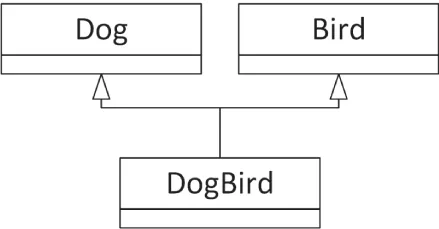
[^FIGURE 10.9]
class Dog{    public:        virtual void bark() { println("Woof!"); }};
class Bird{    public:        virtual void chirp() { println("Chirp!"); }};
class DogBird : public Dog, public Bird{};
Using objects of classes with multiple parents is no different from using objects without multiple parents. In fact, the client code doesn’t even have to know that the class has two parents. All that really matters are the properties and behaviors supported by the class. In this case, a DogBird object supports all of the public member functions of Dog and Bird.
DogBird myConfusedAnimal;myConfusedAnimal.bark();myConfusedAnimal.chirp();The output of this program is as follows:
Woof!Chirp!Naming Collisions and Ambiguous Base Classes
Section titled “Naming Collisions and Ambiguous Base Classes”It’s not difficult to construct a scenario where multiple inheritance would seem to break down. The following examples show some of the edge cases that must be considered.
Name Ambiguity
Section titled “Name Ambiguity”What if the Dog class and the Bird class both had a member function called eat()? Because Dog and Bird are not related in any way, one version of the member function does not override the other—they both continue to exist in the DogBird-derived class.
As long as client code never attempts to call the eat() member function, that is not a problem. The DogBird class compiles correctly despite having two versions of eat(). However, if client code attempts to call the eat() member function on a DogBird, the compiler gives an error indicating that the call to eat() is ambiguous. The compiler does not know which version to call. The following code provokes this ambiguity error:
class Dog{    public:        virtual void bark() { println("Woof!"); }        virtual void eat() { println("The dog ate."); }};
class Bird{    public:        virtual void chirp() { println("Chirp!"); }        virtual void eat() { println("The bird ate."); }};
class DogBird : public Dog, public Bird{};
int main(){    DogBird myConfusedAnimal;    myConfusedAnimal.eat();   // Error! Ambiguous call to member function eat()}
If you comment out the last line from main() calling eat(), the code compiles fine.
The solution to the ambiguity is either to explicitly upcast the object using a dynamic_cast(), essentially hiding the undesired version of the member function from the compiler, or to use a disambiguation syntax. For example, the following code shows two ways to invoke the Dog version of eat():
dynamic_cast<Dog&>(myConfusedAnimal).eat(); // Calls Dog::eat()myConfusedAnimal.Dog::eat(); // Calls Dog::eat()Member functions of the derived class itself can also explicitly disambiguate between different member functions of the same name by using the same syntax used to access parent member functions, that is, the :: scope resolution operator. For example, the DogBird class could prevent ambiguity errors in other code by defining its own eat() member function. Inside this member function, it would determine which parent version to call.
class DogBird : public Dog, public Bird{ public: void eat() override { Dog::eat(); // Explicitly call Dog's version of eat() }};Yet another way to prevent the ambiguity error is to use a using declaration to explicitly state which version of eat() should be inherited in DogBird. Here’s an example:
class DogBird : public Dog, public Bird{ public: using Dog::eat; // Explicitly inherit Dog's version of eat()};Ambiguous Base Classes
Section titled “Ambiguous Base Classes”Another way to provoke ambiguity is to inherit from the same class twice. This can happen if multiple parents themselves have a common parent. For example, perhaps both Bird and Dog are inheriting from an Animal class, as shown in Figure 10.10.
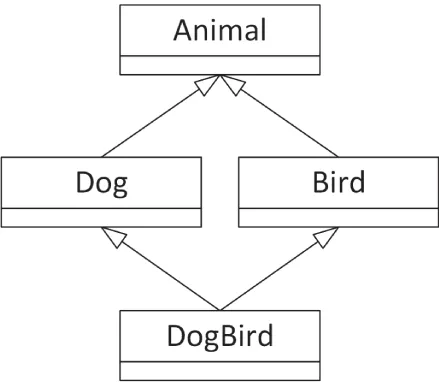
[^FIGURE 10.10]
This type of class hierarchy is permitted in C++, though name ambiguity can still occur. For example, if the Animal class has a public member function called sleep(), that member function cannot be called on a DogBird object because the compiler does not know whether to call the version inherited by Dog or by Bird.
The best way to use these “diamond-shaped” class hierarchies is to make the topmost class an abstract base class with all member functions declared as pure virtual. Because the class only declares member functions without providing definitions, there are no member functions in the base class to call, and thus there are no ambiguities at that level.
The following example implements a diamond-shaped class hierarchy in which the Animal abstract base class has a pure virtual eat() member function that must be defined by each derived class. The DogBird class still needs to be explicit about which parent’s eat() member function it uses, but any ambiguity is caused by Dog and Bird having the same member function, not because they inherit from the same class.
class Animal{    public:        virtual void eat() = 0;};
class Dog : public Animal{    public:        virtual void bark() { println("Woof!"); }        void eat() override { println("The dog ate."); }};
class Bird : public Animal{    public:        virtual void chirp() { println("Chirp!"); }        void eat() override { println("The bird ate."); }};
class DogBird : public Dog, public Bird{    public:        using Dog::eat;};
A more refined mechanism for dealing with the top class in a diamond-shaped hierarchy, virtual base classes, is explained later in this chapter.
Uses for Multiple Inheritance
Section titled “Uses for Multiple Inheritance”At this point, you’re probably wondering why programmers would want to tackle multiple inheritance in their code. The most straightforward use case for multiple inheritance is to define a class of objects that is-a something and also is-a something else. As was said in Chapter 5, any real-world objects you find that follow this pattern are unlikely to translate well into code.
One of the most compelling and simple uses of multiple inheritance is for the implementation of mixin classes. Mixin classes are introduced in Chapter 5 and are discussed in more detail in Chapter 32, “Incorporating Design Techniques and Frameworks.”
Another reason that people sometimes use multiple inheritance is to model a component-based class. Chapter 5 gives the example of an airplane simulator. The Airplane class has an engine, fuselage, controls, and other components. While the typical implementation of an Airplane class would make each of these components a separate data member, you could use multiple inheritance. The airplane class would inherit from engine, fuselage, and controls, in effect getting the behaviors and properties of all of its components. I recommend that you stay away from this type of code because it confuses a clear has-a relationship with inheritance, which should be used for is-a relationships. The recommended solution is to have an Airplane class that contains data members of type Engine, Fuselage, and Controls.
INTERESTING AND OBSCURE INHERITANCE ISSUES
Section titled “INTERESTING AND OBSCURE INHERITANCE ISSUES”Extending a class opens up a variety of issues. What characteristics of the class can and cannot be changed? What is non-public inheritance? What are virtual base classes? These questions, and more, are answered in the following sections.
Changing the Overridden Member Function’s Return Type
Section titled “Changing the Overridden Member Function’s Return Type”For the most part, the reason you override a member function is to change its implementation. Sometimes, however, you may want to change other characteristics of the member function, such as its return type.
A good rule of thumb is to override a member function with the exact member function declaration, or member function prototype, that the base class uses. The implementation can change, but the prototype stays the same.
That does not have to be the case, however. In C++, an overriding member function can change the return type as long as the return type of the member function in the base class is a pointer or reference to a class, and the return type in the derived class is a pointer or reference to a descendant, i.e., more specialized class. Such types are called covariant return types. This feature sometimes comes in handy when the base class and derived class work with objects in a parallel hierarchy—that is, another group of classes that is tangential, but related, to the first class hierarchy.
For example, consider a basic car simulator. You might have two hierarchies of classes that model different real-world objects but are obviously related. The first is the Car hierarchy. The base class, Car, has derived classes GasolineCar and ElectricalCar. Similarly, there is another hierarchy of classes with a base class called PowerSource and derived classes GasolinePowerSource and ElectricalPowerSource. Figure 10.11 shows the two class hierarchies.
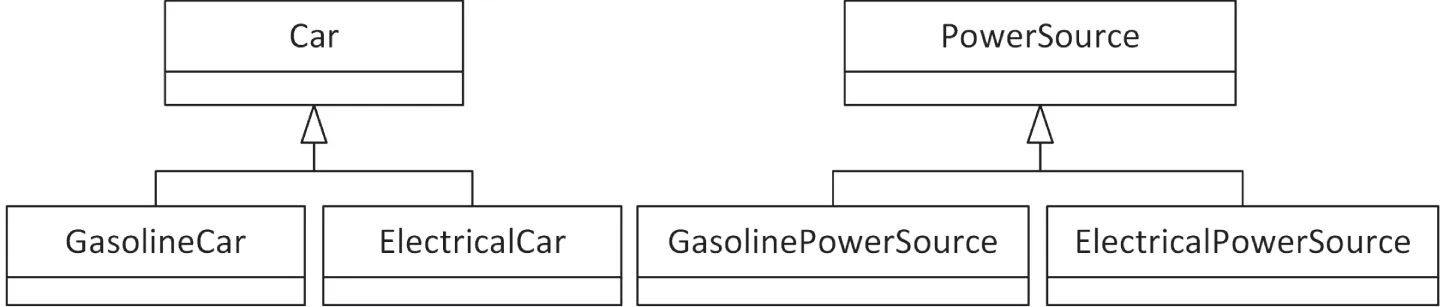
[^FIGURE 10.11]
Let’s assume a power source can print its own type and that a gasoline power source has a member function fillTank(), while an electrical power source has a member function chargeBatteries():
class PowerSource{    public:        virtual void printType() = 0;};
class GasolinePowerSource : public PowerSource{    public:        void printType() override { println("GasolinePowerSource"); }        virtual void fillTank() { println("Gasoline tank filled up."); }};
class ElectricalPowerSource : public PowerSource{    public:        void printType() override { println("ElectricalPowerSource"); }        virtual void chargeBatteries() { println("Batteries charged."); }};
Now assume that Car has a virtual member function called getFilledUpPowerSource() that returns a reference to the “filled-up” power source of a specific car:
class Car{ public: virtual PowerSource& getFilledUpPowerSource() = 0;};This is a pure virtual, abstract member function, as it only makes sense to provide an actual implementation in concrete derived classes. Since a GasolinePowerSource is a PowerSource, the GasolineCar class can implement this member function as follows:
class GasolineCar : public Car{ public: PowerSource& getFilledUpPowerSource() override { m_engine.fillTank(); return m_engine; } private: GasolinePowerSource m_engine;};ElectricalCar can implement it as follows:
class ElectricalCar : public Car{ public: PowerSource& getFilledUpPowerSource() override { m_engine.chargeBatteries(); return m_engine; } private: ElectricalPowerSource m_engine;};These classes can be tested as follows:
GasolineCar gc;gc.getFilledUpPowerSource().printType();println("");ElectricalCar ev;ev.getFilledUpPowerSource().printType();The output is:
Gasoline tank filled up.GasolinePowerSource
Batteries charged.ElectricalPowerSource
This implementation is fine. However, because you know that the getFilledUpPowerSource() member function for GasolineCar always returns a GasolinePowerSource, and for ElectricalCar always an ElectricalPowerSource, you can indicate this fact to potential users of these classes by changing the return type, as shown here:
class GasolineCar : public Car{    public:        GasolinePowerSource& getFilledUpPowerSource() override        { /* omitted for brevity */ }};
class ElectricalCar : public Car{    public:        ElectricalPowerSource& getFilledUpPowerSource() override        { /* omitted for brevity */ }};
A good way to figure out whether you can change the return type of an overridden member function is to consider whether existing code would still work; this is called the Liskov substitution principle (LSP). In the preceding example, changing the return type was fine because any code that assumed that the getFilledUpPowerSource() member function would always return a PowerSource would still compile and work correctly. Because an ElectricalPowerSource and a GasolinePowerSource are both PowerSources, any member functions that were called on the result of getFilledUpPowerSource() returning a PowerSource could still be called on the result of getFilledUpPowerSource() returning an ElectricalPowerSource or a GasolinePowerSource.
You could not, for example, change the return type to something completely unrelated, such as int&. The following code does not compile:
class ElectricalCar : public Car{ public: int& getFilledUpPowerSource() override // Error! { /* omitted for brevity */ }};This generates a compilation error, something like this:
'ElectricalCar::getFilledUpPowerSource': overriding virtual function return type differs and is not covariant from 'Car::getFilledUpPowerSource'This example is using references to PowerSources and not smart pointers. Changing the return type does not work when using, for example, shared_ptr as return type. Suppose Car::getFilledUpPowerSource() returns a shared_ptr<PowerSource>. In that case, you cannot change the return type for ElectricalCar::getFilledUpPowerSource() to shared_ptr<ElectricalPowerSource>. The reason is that shared_ptr is a class template. Two instantiations of the shared_ptr class template are created, shared_ptr<PowerSource> and shared_ptr<ElectricalPowerSource>. Both these instantiations are completely different types and are in no way related to each other. You cannot change the return type of an overridden member function to return a completely different type.
Adding Overloads of virtual Base Class Member Functions to Derived Classes
Section titled “Adding Overloads of virtual Base Class Member Functions to Derived Classes”It is possible to add new overloads of virtual base class member functions to derived classes. That is, you can add an overload of a virtual member function in the derived class with a new prototype but continue to inherit the base class version. This technique uses a using declaration to explicitly include the base class definition of the member function within the derived class. Here is an example:
class Base{    public:        virtual void someFunction();};
class Derived : public Base{ public: using Base::someFunction; // Explicitly inherits the Base version. virtual void someFunction(int i); // Adds a new overload of someFunction(). virtual void someOtherFunction();};Inherited Constructors
Section titled “Inherited Constructors”In the previous section, you saw the use of a using declaration to explicitly include the base class definition of a member function within a derived class. This works for normal class member functions, but also for constructors, allowing you to inherit constructors from base classes. Take a look at the following definitions for the Base and Derived classes:
class Base{    public:        virtual ˜Base() = default;        Base() = default;        explicit Base(int i) {}};
class Derived : public Base{    public:        explicit Derived(int i) : Base(i) {}};
The only thing the Derived constructor is doing is passing its parameter to a Base constructor.
You can construct a Base object only with the provided Base constructors, either the default constructor or the constructor accepting an int. On the other hand, constructing a Derived object can happen only with the provided Derived constructor, which requires a single integer as argument. You cannot construct Derived objects using the default constructor from the Base class. Here is an example:
Base base { 1 }; // OK, calls integer Base ctor.Derived derived1 { 2 }; // OK, calls integer Derived ctor.Derived derived2; // Error, Derived does not have a default ctor.As the Derived constructor is just passing its parameter to a Base constructor and isn’t doing anything else, you can simply inherit the Base constructors explicitly with a using declaration in the Derived class as follows:
class Derived : public Base{ public: using Base::Base;};The using declaration inherits all constructors from Base, so now you can construct Derived objects in the following ways:
Derived derived1 { 2 }; // OK, calls inherited integer Base ctor.Derived derived2; // OK, calls inherited default Base ctor.The inherited constructors in a derived class have the same access specifier (public, protected, or private) as the constructors in the base class. Inherited constructors that are explicitly deleted with =delete in the base class are deleted in the derived class as well.
Hiding of Inherited Constructors
Section titled “Hiding of Inherited Constructors”The Derived class can define a constructor with the same parameter list as one of the inherited constructors in the Base class. In this case, the constructor of the Derived class takes precedence over the inherited constructor. In the following example, the Derived class inherits all constructors, from the Base class with the using declaration. However, because the Derived class defines its own constructor with a single parameter of type float, the inherited constructor from the Base class with a single parameter of type float is hidden.
class Base{    public:        virtual ˜Base() = default;        Base() = default;        explicit Base(std::string_view str) {}        explicit Base(float f) {}};
class Derived : public Base{    public:        using Base::Base;        explicit Derived(float f) {}    // Hides inherited float Base ctor.};
With this definition, objects of Derived can be created as follows:
Derived derived1 { "Hello" }; // OK, calls inherited string_view Base ctor.Derived derived2 { 1.23f }; // OK, calls float Derived ctor.Derived derived3; // OK, calls inherited default Base ctor.A few restrictions apply to inheriting constructors from a base class with a using declaration.
- When you inherit a constructor from a base class, you inherit all of them. It is not possible to inherit only a subset of the constructors of a base class.
- When you inherit constructors, they are inherited with the same access specification as they have in the base class, irrespective of which access specification the
usingdeclaration is under.
Inherited Constructors and Multiple Inheritance
Section titled “Inherited Constructors and Multiple Inheritance”Another restriction with inheriting constructors is related to multiple inheritance. It’s not possible to inherit constructors from one of the base classes if another base class has a constructor with the same parameter list, because this leads to ambiguity. To resolve this, the Derived class needs to explicitly define the conflicting constructors. For example, the following Derived class tries to inherit all constructors from both Base1 and Base2, which results in an ambiguity for the float-based constructors.
class Base1{    public:        virtual ˜Base1() = default;        Base1() = default;        explicit Base1(float f) {}};
class Base2{    public:        virtual ˜Base2() = default;        Base2() = default;        explicit Base2(std::string_view str) {}        explicit Base2(float f) {}};
class Derived : public Base1, public Base2{    public:        using Base1::Base1;        using Base2::Base2;        explicit Derived(char c) {}};
int main(){    Derived d { 1.2f };  // Error, ambiguity.}
The first using declaration in Derived inherits all constructors from Base1. This means that Derived gets the following constructor:
Derived(float f); // Inherited from Base1.The second using declaration in Derived tries to inherit all constructors from Base2. However, this means that Derived gets a second Derived(float) constructor. The problem is solved by explicitly declaring conflicting constructors in the Derived class as follows:
class Derived : public Base1, public Base2{ public: using Base1::Base1; using Base2::Base2; explicit Derived(char c) {} explicit Derived(float f) {}};The Derived class now explicitly declares a constructor with a single parameter of type float, solving the ambiguity. If you want, this explicitly declared constructor in the Derived class accepting a float argument can still forward the call to both the Base1 and Base2 constructors in its ctor-initializer as follows:
Derived::Derived(float f) : Base1 { f }, Base2 { f } {}Initialization of Data Members
Section titled “Initialization of Data Members”When using inherited constructors, make sure that all data members are properly initialized. For example, take the following new definitions for Base and Derived. These definitions do not properly initialize the m_int data member in all cases, and, as you know, uninitialized data members are not recommended.
class Base{    public:        virtual ˜Base() = default;        explicit Base(std::string_view str) : m_str { str } {}    private:        std::string m_str;};
class Derived : public Base{    public:        using Base::Base;        explicit Derived(int i) : Base { "" }, m_int { i } {}    private:        int m_int;};
You can create a Derived object as follows:
Derived s1 { 2 };This calls the Derived(int) constructor, which initializes the m_int data member of the Derived class and calls the Base constructor with an empty string to initialize the m_str data member.
Because the Base constructor is inherited in the Derived class, you can also construct a Derived object as follows:
Derived s2 { "Hello World" };This calls the inherited Base constructor in the Derived class. However, this inherited Base constructor only initializes m_str of the Base class and does not initialize m_int of the Derived class, leaving it in an uninitialized state. This is not recommended!
The solution in this case is to use in-class member initializers, which are discussed in Chapter 8. The following code uses an in-class member initializer to initialize m_int to 0. Of course, the Derived(int) constructor can still change this and initialize m_int to the constructor parameter i.
class Derived : public Base{ public: using Base::Base; explicit Derived(int i) : Base { "" }, m_int { i } {} private: int m_int { 0 };};Special Cases in Overriding Member Functions
Section titled “Special Cases in Overriding Member Functions”Several special cases require attention when overriding a member function. This section outlines the cases that you are likely to encounter.
The Base Class Member Function Is static
Section titled “The Base Class Member Function Is static”In C++, you cannot override a static member function. For the most part, that’s all you need to know. There are, however, a few corollaries that you need to understand.
First of all, a member function cannot be both static and virtual. This is the first clue that attempting to override a static member function will not do what you intend it to do. If you have a static member function in your derived class with the same name as a static member function in your base class, you actually have two separate member functions.
The following code shows two classes that both happen to have static member functions called beStatic(). These two member functions are in no way related.
class BaseStatic{    public:        static void beStatic() { println("BaseStatic being static."); }};
class DerivedStatic : public BaseStatic{    public:        static void beStatic() { println("DerivedStatic keepin' it static."); }};
Because a static member function belongs to its class, calling the identically named member functions on the two different classes calls their respective member functions.
BaseStatic::beStatic();DerivedStatic::beStatic();This outputs the following:
BaseStatic being static.DerivedStatic keepin' it static.Everything makes perfect sense as long as the member functions are accessed by their class names. The behavior is less clear when objects are involved. In C++, you can call a static member function using an object, but because the member function is static, it has no this pointer and no access to the object itself, so it is equivalent to calling it by its class name. Referring to the previous example classes, you can write code as follows, but the results may be surprising.
DerivedStatic myDerivedStatic;BaseStatic& ref { myDerivedStatic };myDerivedStatic.beStatic();ref.beStatic();The first call to beStatic() obviously calls the DerivedStatic version because it is explicitly called on an object declared as a DerivedStatic. The second call might not work as you expect. The object is a BaseStatic reference, but it refers to a DerivedStatic object. In this case, BaseStatic’s version of beStatic() is called. The reason is that C++ doesn’t care what the object actually is when calling a static member function. It only cares about the compile-time type. In this case, the type is a reference to a BaseStatic.
The output of the previous example is as follows:
DerivedStatic keepin' it static.BaseStatic being static.The Base Class Member Function Is Overloaded
Section titled “The Base Class Member Function Is Overloaded”When you override a member function by specifying a name and a set of parameters, the compiler implicitly hides all other instances of the same name in the base class. The idea is that if you have overridden one member function with a given name, you might have intended to override all the member functions with that name, but simply forgot, and therefore this should be treated as an error. It makes sense if you think about it—why would you want to change some overloads of a member function and not others? Consider the following Derived class, which overrides a member function without overriding its associated overloaded siblings:
class Base{    public:        virtual ˜Base() = default;        virtual void overload() { println("Base's overload()"); }        virtual void overload(int i) { println("Base's overload(int i)"); }};
class Derived : public Base{    public:        void overload() override { println("Derived's overload()"); }};
If you attempt to call the version of overload() that takes an int parameter on a Derived object, your code will not compile because it was not explicitly overridden.
Derived myDerived;myDerived.overload(2); // Error! No matching member function for overload(int).It is possible, however, to access this version of the member function from a Derived object. All you need is a pointer or a reference to a Base object.
Derived myDerived;Base& ref { myDerived };ref.overload(7);The hiding of unimplemented overloaded member functions is only skin deep in C++. Objects that are explicitly declared as instances of the derived class do not make the member functions available, but a simple cast to the base class brings them right back.
A using declaration can be employed to save you the trouble of overriding all the overloads when you really only want to change one. In the following code, the Derived class definition uses one version of overload() from Base and explicitly overrides the other:
class Derived : public Base{ public: using Base::overload; void overload() override { println("Derived's overload()"); }};The using declaration has certain risks. Suppose a third overload() member function is added to Base, which should have been overridden in Derived. This will now not be detected as an error, because with the using declaration, the designer of the Derived class has explicitly said, “I am willing to accept all other overloads of this member function from the parent class.”
To avoid obscure bugs when overriding a member function from a base class, override all overloads of that member function as well.
The Base Class Member Function Is private
Section titled “The Base Class Member Function Is private”There’s absolutely nothing wrong with overriding a private member function. Remember that the access specifier for a member function determines who is able to call the member function. Just because a derived class can’t call its parent’s private member functions doesn’t mean it can’t override them. In fact, the template member function pattern is a common pattern in C++ that is implemented by overriding private member functions. It allows derived classes to define their own “uniqueness” that is referenced in the base class. Note that, for example, Java and C# only allow overriding public and protected member functions, not private member functions.
For example, the following class is part of a car simulator that estimates the number of miles the car can travel based on its gas mileage and the amount of fuel left. The getMilesLeft() member function is the template member function. Usually, template member functions are not virtual. They typically define some algorithmic skeleton in a base class, calling virtual member functions to query for information. A derived class can then override these virtual member functions to change aspects of the algorithm without having to modify the algorithm in the base class itself.
export class MilesEstimator{ public: virtual ˜MilesEstimator() = default; int getMilesLeft() const { return getMilesPerGallon() * getGallonsLeft(); } virtual void setGallonsLeft(int gallons) { m_gallonsLeft = gallons; } virtual int getGallonsLeft() const { return m_gallonsLeft; } private: int m_gallonsLeft { 0 }; virtual int getMilesPerGallon() const { return 20; }};The getMilesLeft() member function performs a calculation based on the results of two of its own member functions: getGallonsLeft() which is public, and getMilesPerGallon() which is private. The following code uses the MilesEstimator to calculate how many miles can be traveled with two gallons of gas:
MilesEstimator myMilesEstimator;myMilesEstimator.setGallonsLeft(2);println("Normal estimator can go {} more miles.", myMilesEstimator.getMilesLeft());The output of this code is as follows:
Normal estimator can go 40 more miles.To make the simulator more interesting, you may want to introduce different types of vehicles, perhaps a more efficient car. The existing MilesEstimator assumes that all cars get 20 miles per gallon, but this value is returned from a separate member function specifically so that a derived class can override it. Such a derived class is shown here:
export class EfficientCarMilesEstimator : public MilesEstimator{ private: int getMilesPerGallon() const override { return 35; }};By overriding this one private member function, the new class completely changes the behavior of existing, unmodified, public member functions in the base class. The getMilesLeft() member function in the base class automatically calls the overridden version of the private getMilesPerGallon() member function. An example using the new class is shown here:
EfficientCarMilesEstimator myEstimator;myEstimator.setGallonsLeft(2);println("Efficient estimator can go {} more miles.", myEstimator.getMilesLeft());This time, the output reflects the overridden functionality:
Efficient estimator can go 70 more miles.The Base Class Member Function Has Default Arguments
Section titled “The Base Class Member Function Has Default Arguments”An overridden member function in a derived class can have different default arguments than in the base class. The arguments that are used depend on the declared type of the variable, not the underlying object. The following is a simple example of a derived class that provides a different default argument in an overridden member function:
class Base{    public:        virtual ˜Base() = default;        virtual void go(int i = 2) { println("Base's go with i={}", i); }};
class Derived : public Base{    public:        void go(int i = 7) override { println("Derived's go with i={}", i); }};
If go() is called on a Derived object, Derived’s version of go() is executed with the default argument of 7. If go() is called on a Base object, Base’s version of go() is called with the default argument of 2. However (and this is the weird part), if go() is called on a Base pointer or Base reference that really points to a Derived object, Derived’s version of go() is called but with Base’s default argument of 2. This behavior is shown in the following example:
Base myBase;Derived myDerived;Base& myBaseReferenceToDerived { myDerived };myBase.go();myDerived.go();myBaseReferenceToDerived.go();The output of this code is as follows:
Base's go with i=2Derived's go with i=7Derived's go with i=2The reason for this behavior is that C++ uses the compile-time type of the expression to bind default arguments, not the run-time type. Default arguments are not “inherited” in C++. If the Derived class in this example failed to provide a default argument for go() as its parent did, it would not be possible to call go() on a Derived object without passing an argument to it.
The Base Class Member Function Has a Different Access Specification
Section titled “The Base Class Member Function Has a Different Access Specification”There are two ways you may want to change the access specification of a member function: you could try to make it more restrictive or less restrictive. Neither case makes much sense in C++, but there are a few legitimate reasons for attempting to do so.
To enforce tighter restrictions on a member function (or on a data member for that matter), there are two approaches you can take. One way is to change the access specifier for the entire base class. This approach is described later in this chapter. The other approach is simply to redefine the access in the derived class, as illustrated in the Shy class that follows:
class Gregarious{    public:        virtual void talk() { println("Gregarious says hi!"); }};
class Shy : public Gregarious{    protected:        void talk() override { println("Shy reluctantly says hello."); }};
The protected version of talk() in Shy properly overrides the Gregarious::talk() member function. Any client code that attempts to call talk() on a Shy object gets a compilation error:
Shy myShy;myShy.talk(); // Error! Attempt to access protected member function.However, the member function is not fully protected. One only has to obtain a Gregarious reference or pointer to access the member function that you thought was protected:
Shy myShy;Gregarious& ref { myShy };ref.talk();The output of this code is as follows:
Shy reluctantly says hello.This proves that making the member function protected in the derived class did override the member function (because the derived class version is correctly called), but it also proves that the protected access can’t be fully enforced if the base class makes it public.
It is much easier (and makes more sense) to lessen access restrictions in derived classes. The simplest way is to provide a public member function in the derived class that calls a protected member function from the base class, as shown here:
class Secret{    protected:        virtual void dontTell() { println("I'll never tell."); }};
class Blabber : public Secret{    public:        virtual void tell() { dontTell(); }};
A client calling the public tell() member function of a Blabber object effectively accesses the protected member function of the Secret class. Of course, this doesn’t really change the access specification of dontTell(); it just provides a public way of accessing it.
You can also override dontTell() explicitly in Blabber and give it new behavior with public access. This makes a lot more sense than reducing the access specification because it is entirely clear what happens with a reference or pointer to the base class. For example, suppose that Blabber actually makes the dontTell() member function public:
class Blabber : public Secret{ public: void dontTell() override { println("I'll tell all!"); }};Now you can call dontTell() on a Blabber object:
myBlabber.dontTell(); // Outputs "I'll tell all!"If you don’t want to change the implementation of the overridden member function but only change the access specification, then you can use a using declaration. Here’s an example:
class Blabber : public Secret{ public: using Secret::dontTell;};This also allows you to call dontTell() on a Blabber object, but this time the output will be “I’ll never tell”:
myBlabber.dontTell(); // Outputs "I'll never tell."In both previous cases, however, the protected member function in the base class stays protected because any attempts to call Secret’s dontTell() member function through a Secret pointer or reference will not compile:
Blabber myBlabber;Secret& ref { myBlabber };Secret* ptr { &myBlabber };ref.dontTell(); // Error! Attempt to access protected member function.ptr->dontTell(); // Error! Attempt to access protected member function.Copy Constructors and Assignment Operators in Derived Classes
Section titled “Copy Constructors and Assignment Operators in Derived Classes”Chapter 9 explains that providing a copy constructor and assignment operator is a must when you have dynamically allocated memory in a class. When defining a derived class, you need to be careful about copy constructors and operator=.
If your derived class does not have any special data (pointers, usually) that require a nondefault copy constructor or operator=, you don’t need to have one, regardless of whether the base class has one. If your derived class omits the copy constructor or operator=, a default copy constructor or operator= will be provided for the data members specified in the derived class, and the base class copy constructor or operator= will be used for the data members specified in the base class.
On the other hand, if you do specify a copy constructor in the derived class, you need to explicitly call the parent copy constructor, as shown in the following code. If you do not do this, the default constructor (not the copy constructor!) will be used for the parent portion of the object.
class Base{    public:        virtual ˜Base() = default;        Base() = default;        Base(const Base& src) { }};
class Derived : public Base{    public:        Derived() = default;        Derived(const Derived& src) : Base { src } { }};
Similarly, if the derived class overrides operator=, it is almost always necessary to call the parent’s version of operator= as well. The only case where you wouldn’t do this would be if there was some bizarre reason why you only wanted part of the object assigned when an assignment took place. The following code shows how to call the parent’s assignment operator from the derived class:
Derived& Derived::operator=(const Derived& rhs){ if (&rhs == this) { return *this; } Base::operator=(rhs); // Calls parent's operator=. // Do necessary assignments for derived class. return *this;}If your derived class does not specify its own copy constructor or operator=, the base class functionality continues to work. However, if the derived class does provide its own copy constructor or operator=, it needs to explicitly call the base class versions.
Run-Time Type Facilities
Section titled “Run-Time Type Facilities”Relative to other object-oriented languages, C++ is very compile-time oriented. As you learned earlier, overriding member functions works because of a level of indirection between a member function and its implementation, not because the object has built-in knowledge of its own class.
There are, however, features in C++ that provide a run-time view of an object. These features are commonly grouped together under a feature set called run-time type information (RTTI). RTTI provides a number of useful features for working with information about an object’s class membership. One such feature is dynamic_cast(), which allows you to safely convert between types within an object-oriented hierarchy; this was discussed earlier in this chapter. Using dynamic_cast() on a class without a vtable, that is, without any virtual member functions, causes a compilation error.
A second RTTI feature is the typeid operator, which lets you query for types at run time. The result of applying the operator is a reference to an std::type_info object, defined in <typeinfo>. The type_info class has a member function called name() returning the compiler-dependent name of the type. The typeid operator behaves as follows:
typeid(type): Results in a reference to atype_infoobject representing the given type.typeid(expression)- If evaluating
expressionresults in a polymorphic type, thenexpressionis evaluated and the result of thetypeidoperator is a reference to atype_infoobject representing the dynamic type of the evaluatedexpression. - Otherwise,
expressionis not evaluated, and the result is a reference to atype_infoobject representing the static type.
- If evaluating
For the most part, you shouldn’t ever need to use typeid because any code that is conditionally executed based on the type of the object would be better handled with, for example, virtual member functions.
The following code uses typeid to print a message based on the type of the object:
class Animal { public: virtual ˜Animal() = default; };class Dog : public Animal {};class Bird : public Animal {};
void speak(const Animal& animal){    if (typeid(animal) == typeid(Dog)) {        println("Woof!");    } else if (typeid(animal) == typeid(Bird)) {        println("Chirp!");    }}
Whenever you see code like this, you should immediately consider reimplementing the functionality as a virtual member function. In this case, a better implementation would be to declare a virtual member function called speak() in the Animal base class. Dog would override the member function to print "Woof!", and Bird would override it to print "Chirp!". This approach better fits object-oriented programming, where functionality related to objects is given to those objects.
The typeid operator works correctly only if the class has at least one virtual member function, that is, when the class has a vtable. Additionally, the typeid operator strips reference and const qualifiers from its argument.
One possible use case of the typeid operator is for logging and debugging purposes. The following code makes use of typeid for logging. The logObject() function takes a “loggable” object as a parameter. The design is such that any object that can be logged inherits from the Loggable class and supports a member function called getLogMessage().
class Loggable{    public:        virtual ˜Loggable() = default;        virtual string getLogMessage() const = 0;};
class Foo : public Loggable{    public:        string getLogMessage() const override { return "Hello logger."; }};
void logObject(const Loggable& loggableObject){    print("{}: ", typeid(loggableObject).name());    println("{}", loggableObject.getLogMessage());}
logObject() first prints the name of the object’s class to the console, followed by its log message. This way, when you read the log later, you can see which object was responsible for every written line. Here is the output generated by Microsoft Visual C++ 2022 when logObject() is called with an instance of Foo:
The output is as follows:
class Foo: Hello logger.As you can see, the name returned by the typeid operator is “class Foo”. However, this name depends on your compiler. For example, if you compile and run the same code with GCC, the output is as follows:
The output is:
3Foo: Hello logger.Non-public Inheritance
Section titled “Non-public Inheritance”In all previous examples, parent classes were always listed using the public keyword. You may be wondering if a parent can be private or protected. In fact, it can, though neither is as common as public. If you don’t specify any access specifier for the parent, then it is private inheritance for a class, and public inheritance for a struct.
Declaring the relationship with the parent to be protected means that all public member functions and data members from the base class become protected in the context of the derived class. Similarly, specifying private inheritance means that all public and protected member functions and data members of the base class become private in the derived class.
There are a handful of reasons why you might want to uniformly degrade the access level of the parent in this way, but most reasons imply flaws in the design of the hierarchy. Some programmers abuse this language feature, often in combination with multiple inheritance, to implement “components” of a class. Instead of making an Airplane class that contains an engine data member and a fuselage data member, they make an Airplane class that is a protected engine and a protected fuselage. In this way, the Airplane doesn’t look like an engine or a fuselage to client code (because everything is protected), but it is able to use all of that functionality internally.
Virtual Base Classes
Section titled “Virtual Base Classes”Earlier in this chapter, you learned about ambiguous base classes, a situation that arises when multiple parents each have a parent in common, as shown again in Figure 10.12. The solution recommended earlier was to make sure that the shared parent doesn’t have any functionality of its own. That way, its member functions can never be called, and there is no ambiguity problem.
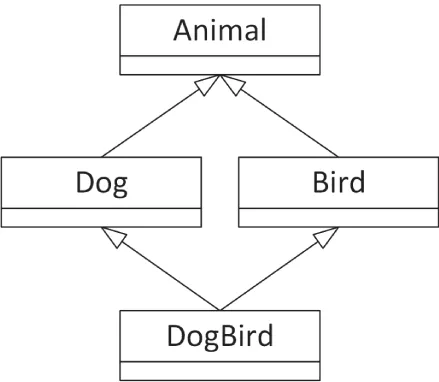
[^FIGURE 10.12]
C++ has another mechanism, called virtual base classes, for addressing this problem if you do want the shared parent to have its own functionality. If the shared parent is marked as a virtual base class, there will not be any ambiguity. The following code adds a sleep() member function, including an implementation, to the Animal base class, and modifies the Dog and Bird classes to inherit from Animal as a virtual base class. Without using a virtual base class, a call to sleep() on a DogBird object would be ambiguous and would generate a compiler error because DogBird would have two subobjects of class Animal, one coming from Dog and one coming from Bird. However, when Animal is inherited virtually, DogBird has only one subobject of class Animal, so there will be no ambiguity with calling sleep().
class Animal{    public:        virtual void eat() = 0;        virtual void sleep() { println("zzzzz…."); }};
class Dog : public virtual Animal{    public:        virtual void bark() { println("Woof!"); }        void eat() override { println("The dog ate."); }};
class Bird : public virtual Animal{    public:        virtual void chirp() { println("Chirp!"); }        void eat() override { println("The bird ate."); }};
class DogBird : public Dog, public Bird{    public:        void eat() override { Dog::eat(); }};
int main(){    DogBird myConfusedAnimal;    myConfusedAnimal.sleep();  // Not ambiguous because of virtual base class.}
Be careful with constructors in such class hierarchies. For example, the following code adds some data members to the different classes, adds constructors to initialize those data members, and, for reasons explained after the code snippet, adds a protected default constructor to Animal.
class Animal{    public:        explicit Animal(double weight) : m_weight { weight } {}        virtual double getWeight() const { return m_weight; }    protected:        Animal() = default;    private:        double m_weight { 0.0 };};
class Dog : public virtual Animal{    public:        explicit Dog(double weight, string name)            : Animal { weight }, m_name { move(name) } {}    private:        string m_name;};
class Bird : public virtual Animal{    public:        explicit Bird(double weight, bool canFly)            : Animal { weight }, m_canFly { canFly } {}    private:        bool m_canFly { false };};
class DogBird : public Dog, public Bird{    public:        explicit DogBird(double weight, string name, bool canFly)            : Dog { weight, move(name) }, Bird { weight, canFly } {}};
int main(){    DogBird dogBird { 22.33, "Bella", true };    println("Weight: {}", dogBird.getWeight());}
When you run this code, the output is unexpected: The output is as follows:
Weight: 0It seems that the given weight of 22.33 when constructing the DogBird in main() is lost. Why? This code is using a virtual Animal base class; hence, a DogBird instance has only one Animal subobject. The DogBird constructor calls the constructors of both Dog and Bird, which both forward to their Animal base class constructor. This would mean that Animal is constructed twice. This is not allowed. In such cases, the compiler disables the call to the Animal constructor in the Dog and Bird constructors when it’s being called from a derived class’s constructor and, instead, calls a default constructor of the Animal base class, thus the need for the protected default constructor in Animal. All this means that the most derived class itself is responsible for calling a constructor of the shared base class. A correct implementation is as follows:
class Animal { /* Same as before. */ };
class Dog : public virtual Animal{    public:        explicit Dog(double weight, string name)            : Animal { weight }, m_name { move(name) } {}    protected:        explicit Dog(string name) : m_name { move(name) } {}    private:        string m_name;};
class Bird : public virtual Animal{    public:        explicit Bird(double weight, bool canFly)            : Animal { weight }, m_canFly { canFly } {}    protected:        explicit Bird(bool canFly) : m_canFly { canFly } {}    private:        bool m_canFly { false };};
class DogBird : public Dog, public Bird{    public:        explicit DogBird(double weight, string name, bool canFly)            : Animal { weight }, Dog { move(name) }, Bird { canFly } {}};
In this implementation, protected single-argument constructors are added to Dog and Bird. They are protected as they should be used only by derived classes. Client code is allowed to construct Dogs and Birds only using the two-argument constructors.
After these changes, the output is correct: The output is:
Weight: 22.33The basic types in C++ are reviewed in Chapter 1, while Chapters 8 through 10 show how to write your own types with classes. This section explores some of the trickier aspects of casting one type to another type.
C++ provides five specific casts: const_cast(), static_cast(), reinterpret_cast(), dynamic_cast(), and std::bit_cast(). The first one is discussed in Chapter 1. Chapter 1 also introduces static_cast() for casting between certain primitive types, but there is more to say about it in the context of inheritance. Now that you are fluent in writing your own classes and understand class inheritance, it’s time to take a closer look at these casts.
Note that the old C-style casts such as (int)myFloat still work in C++ and are still used extensively in existing code bases. C-style casts cover all C++ casts except bit_cast() and thus are more error-prone because it’s not always obvious what you are trying to achieve, and you might end up with unexpected results. I strongly recommend you only use the C++ style casts in new code because they are safer and stand out better syntactically and visually in your code.
static_cast()
Section titled “static_cast()”You can use static_cast() to perform explicit conversions that are supported directly by the language. For example, if you write an arithmetic expression in which you need to convert an int to a double to avoid integer division, use a static_cast(). In this example, it’s enough to only use static_cast() with i, because that makes one of the two operands a double, making sure C++ performs floating-point division.
int i { 3 };int j { 4 };double result { static_cast<double>(i) / j };You can also use static_cast() to perform explicit conversions that are allowed because of user-defined constructors or conversion routines. For example, if class A has a constructor that takes an object of class B, you can convert a B object to an A object using a static_cast(). In most situations where you want this behavior, however, the compiler performs the conversion automatically.
Another use for static_cast() is to perform downcasts in an inheritance hierarchy, as in this example:
class Base{    public:        virtual ˜Base() = default;};
class Derived : public Base{    public:        virtual ˜Derived() = default;};
int main(){    Base* b { nullptr };    Derived* d { new Derived {} };    b = d; // Don't need a cast to go up the inheritance hierarchy.    d = static_cast<Derived*>(b); // Need a cast to go down the hierarchy.
    Base base;    Derived derived;    Base& br { derived };    Derived& dr { static_cast<Derived&>(br) };}
These casts work with both pointers and references. They do not work with objects themselves.
Note that casts using static_cast() do not perform run-time type checking. They allow you to convert any Base pointer to a Derived pointer, or Base reference to a Derived reference, even if the Base really isn’t a Derived at run time. For example, the following code compiles and executes, but using the pointer d can result in potentially catastrophic failure, including memory overwrites outside the bounds of the object.
Base* b { new Base {} };Derived* d { static_cast<Derived*>(b) };To perform such casts safely with run-time type checking, use dynamic_cast(), which is explained a bit later in this chapter.
static_cast() is not all-powerful. You can’t static_cast() pointers of one type to pointers of another unrelated type. You can’t directly static_cast() objects of one type to objects of another type if there is no converting constructor available. You can’t static_cast() a const type to a non-const type. You can’t static_cast() pointers to ints. Basically, you can only do things that make sense according to the type rules of C++.
reinterpret_cast()
Section titled “reinterpret_cast()”reinterpret_cast() is a bit more powerful, and concomitantly less safe, than static_cast(). You can use it to perform some casts that are not technically allowed by the C++ type rules but that might make sense to the programmer in some circumstances. For example, you can use reinterpret_cast() to cast a reference to one type to a reference to another type, even if the types are unrelated. Similarly, you can use it to cast a pointer type to any other pointer type, even if they are unrelated by an inheritance hierarchy. However, casting a pointer to a void* can be done implicitly, without an explicit cast. To cast a void* back to a correctly typed pointer, a static_cast() is enough. A void* pointer is just a pointer to some location in memory. No type information is associated with a void* pointer. Here are some examples:
class X {};class Y {};
int main(){    X x;    Y y;    X* xp { &x };    Y* yp { &y };    // Need reinterpret_cast for pointer conversion from unrelated classes    // static_cast doesn't work.    xp = reinterpret_cast<X*>(yp);    // No cast required for conversion from pointer to void*    void* p { xp };    // static_cast is enough for pointer conversion from void*    xp = static_cast<X*>(p);    // Need reinterpret_cast for reference conversion from unrelated classes    // static_cast doesn't work.    X& xr { x };    Y& yr { reinterpret_cast<Y&>(x) };}
reinterpret_cast() is not all-powerful; it comes with quite a few restrictions on what can be cast to what. These restrictions are not further discussed in this text, as I recommend that you use these kinds of casts judiciously.
In general, you should be careful with reinterpret_cast() because it allows you to do conversions without performing any type checking.
You can also use reinterpret_cast() to cast pointers to integral types and back. However, you can only cast a pointer to an integral type that is large enough to hold it. For example, trying to use reinterpret_cast() to cast a 64-bit pointer to a 32-bit integer results in a compilation error.
dynamic_cast()
Section titled “dynamic_cast()”dynamic_cast() provides a run-time check on casts within an inheritance hierarchy. You can use it to cast pointers or references. dynamic_cast() checks the run-time type information of the underlying object at run time. If the cast doesn’t make sense, dynamic_cast() returns a null pointer (for the pointer version) or throws an std::bad_cast exception (for the reference version).
For example, suppose you have the following class hierarchy:
class Base{    public:        virtual ˜Base() = default;};
class Derived : public Base{    public:        virtual ˜Derived() = default;};
The following example shows a correct use of dynamic_cast():
Base* b;Derived* d { new Derived {} };b = d;d = dynamic_cast<Derived*>(b);The following dynamic_cast() on a reference will cause an exception to be thrown:
Base base;Derived derived;Base& br { base };try { Derived& dr { dynamic_cast<Derived&>(br) };} catch (const bad_cast&) { println("Bad cast!");}Note that you can perform the same casts down the inheritance hierarchy with a static_cast() or reinterpret_cast(). The difference with dynamic_cast() is that it performs run-time (dynamic) type checking, while static_cast() and reinterpret_cast() perform the cast even if they are erroneous.
Remember, the run-time type information is stored in the vtable of an object. Therefore, to use dynamic_cast(), your classes must have at least one virtual member function. If your classes don’t have a vtable, trying to use dynamic_cast() will result in a compilation error. Microsoft Visual C++, for example, gives the following error:
error C2683: 'dynamic_cast' : 'Base' is not a polymorphic type.std::bit_cast()
Section titled “std::bit_cast()”std::bit_cast() is defined in <bit>. It’s the only cast that’s part of the Standard Library; the other casts are part of the C++ language itself. bit_cast() resembles reinterpret_cast(), but it creates a new object of a given target type and copies the bits from a source object to this new object. It effectively interprets the bits of the source object as if they are the bits of the target object. bit_cast() requires that the size of the source and target objects are the same and that both are trivially copyable.
Here is an example:
float asFloat { 1.23f };auto asUint { bit_cast<unsigned int>(asFloat) };if (bit_cast<float>(asUint) == asFloat) { println("Roundtrip success."); }A use case for bit_cast() is with binary I/O of trivially copyable types. For example, you can write the individual bytes of such types to a file. When you read the file back into memory, you can use bit_cast() to correctly interpret the bytes read from the file.
Summary of Casts
Section titled “Summary of Casts”The following table summarizes the casts you should use for different situations.
| SITUATION | CAST |
|---|---|
Remove const-ness | const_cast() |
Explicit cast supported by the language (for example, int to double, int to bool) | static_cast() |
| Explicit cast supported by user-defined constructors or conversions | static_cast() |
| Object of one class to object of another (unrelated) class | bit_cast() |
| Pointer-to-object of one class to pointer-to-object of another class in the same inheritance hierarchy | dynamic_cast() recommended, or static_cast() |
| Reference-to-object of one class to reference-to-object of another class in the same inheritance hierarchy | dynamic_cast() recommended, or static_cast() |
| Pointer-to-type to unrelated pointer-to-type | reinterpret_cast() |
| Reference-to-type to unrelated reference-to-type | reinterpret_cast() |
| Pointer-to-function to pointer-to-function | reinterpret_cast() |
SUMMARY
Section titled “SUMMARY”This chapter covered numerous details about inheritance. You learned about its many applications, including code reuse and polymorphism. You also learned about its many abuses, including poorly designed multiple-inheritance schemes. Along the way, you uncovered some cases that require special attention.
Inheritance is a powerful language feature that takes some time to get used to. After you have worked with the examples in this chapter and experimented on your own, I hope that inheritance will become your tool of choice for object-oriented design.
EXERCISES
Section titled “EXERCISES”By solving the following exercises, you can practice the material discussed in this chapter. Solutions to all exercises are available with the code download on the book’s website at www.wiley.com/go/proc++6e. However, if you are stuck on an exercise, first reread parts of this chapter to try to find an answer yourself before looking at the solution from the website.
-
Exercise 10-1: Take the
Personclass from Exercise 9-2 and add a derived class calledEmployee. You can omit the overload ofoperator<=>from Exercise 9-2. TheEmployeeclass adds one data member, an employee ID. Provide an appropriate constructor. FromEmployee, derive two more classes calledManagerandDirector.Put all your classes, including the
Personclass, in a namespace calledHR. Note that you can export everything in a namespace from a module as follows:export namespace HR { /* … */ } -
Exercise 10-2: Continuing with your solution from Exercise 10-1, add a
toString()member function to thePersonclass returning a string representation of a person. Override this member function in theEmployee,Manager, andDirectorclasses to build up a complete string representation by delegating part of their work to parent classes. -
Exercise 10-3: Practice polymorphic behavior of the classes in your
Personhierarchy from Exercise 10-2. Define avectorto store a mix of persons, employees, managers, and directors, and fill it with some test data. Finally, use a single range-basedforloop to calltoString()on all of the elements in thevector. -
Exercise 10-4: In real companies, employees can get promoted to manager or director positions, and managers can get promoted to director. Do you see a way you can add support for this to your class hierarchy of Exercise 10-3?